Friday, May 25, 2007

Soul Britannia: It's All Over Now...

It was their most intimidating audience to date.

As they entered the Co-Op Ballroom in Nuneaton, Mick Jagger, Keith Richards, Charlie Watts, Brian Jones, Bill Wyman and Ian Stewart did not know what to expect. Tension was high. They set up, were introduced, and began to play their brand of rhythm and blues...

The audience, mostly children from the age of 4 to 10, were not impressed, and proceeded to pummel the Rolling Stones continuously with cream cakes until they left the stage.

"They did not appreciate r&b", said Bill Wyman sadly, looking back on that ordeal.


For the fledgeling r&b band, success and recognition was not coming easy. It was all very well to play at The Marquee on the nights when Blues Incorporated were unavailable, but other venues and appreciative audiences were still very thin on the ground.

But, in 1963, while the Stones searched for gigs and practiced being jammy dodgers, the r&b scene that had grown around the clubs of London was now spreading. The Ealing Club grew from 100 members the first week to 200 memebers the next, to over 800 by the end of 1962, some having wandered to its doors in search of the blues from as far away as Scotland. By 1964, most of the clubs of Wardour Street and West London had gone over to featuring r&b over modern jazz. The Stones finally found a home away from the Marquee, this time in Richmond, at the Crawdaddy Club. Richmond could boast a number of other venues turning to r&b, such as the Eel Pie Hotel, The Station Hotel, The Imperial, and L’Auberge. Approximately 10,000 people were likely to enter the doors of these London clubs alone in a typical week to pick up the r&b sounds.

And the trend had spread outside the capital. By late 1963, rhythm & blues clubs were forming all over: from St Andrew's Hall in Norwich, the Olympia in Reading, the R&B Club in Andover, the Rhythm & Blues Club at the Maritime Hotel in Belfast, and the Downbeat Club and Club A-G0-Go in Newcastle, to the Starlight Rooms in Brighton. It must be said, however, that while now these clubs were bringing r&b closer to British youth, they are all situated in ports, near American bases or close to London.

Rhythm and blues was going to be the new musical wave, then, after all. It had not been inevitable, or even likely. But for a number of reasons, r&b now appealed. It is often suggested that this was simply because Britain was still haunted by the spectre of World War II, and had a yearning for the trappings of America. Yet as my dad told me recently, there had been a number of reasons why rock and roll had become adulterated and tamed in its British version by the early 60s:

"You have to remember, for a lot of people, even young people, rock and roll had been connected with the Teds. Many ordinary people thought they were violent, dangerous thugs. They were outcasts, troublemakers from the working class [so people assumed]... So a lot of people wanted nothing to do with anything these troublemakers enjoyed. In any given week, at least half of the Hit parade would be filled up with ballads and popular tunes by people like Alma Cogan. That's what most people wanted to hear, right up to the mid Sixties."

In fact, Britain benefitted from a veneer of prosperity and more spending power in people's pocket, largely due to the removal of rationing and a series of canny devaluations by the MacMillan government during the late 50s. More and more young people were growing up into a comfortable suburban life that had cultural, educational and creative advantages. There was more money for instruments, more opportunity to enjoy the nightlife, the chance for free university education and growing enrollment at art schools. Here, a relatively small number of young people were introduced to jazz and then the blues, and had a chance to play and experiment. So affluence, leisure time and money in pockets was making it possible to adopt new American trends, after a fashion, in a way that had never truly happened in Britain before.

Some have said that in fact it was easier for British youth to take up r&b than it was for their contemporary white Americans. This is perhaps an oversimplification, as it ignores the way southern soul in particular was formed interracially in Memphis and Muscle Shoals, to name but two examples. However, naively obsessed with all things American, with access to far fewer media accounts of the realities of American society, British youth were far happier than white Americans to simply accept that jazz, blues and r&b was at the heart of 'American' music. The main objection to r&b in Britain was its noisiness, young people's unprofessional musicianship and the length and cleanliness of the bands' hair.

Was the music that they made r&b? It was certainly different to the rhythm & blues Americans were used to, They couldn't play as well, they couldn't sing at all American, and they had nobody to refer to except for the twenty or so records they had in their bedroom. They had grown up with very different influences to their black American heroes, from skiffle, to old folk ballads, to music hall songs, and these influences naturally permeated the songs that they began to write for themselves. So ultimately, British r&b changed into something unlike its beginnings, and took a course far removed from the course of black American music in the late 60s and 70s. But it was inspired by and dedicated to the seven-inch pieces of vinyl they had listened to note for note in those early years...

SO, who was playing this r&b hybrid? Time for some more music posts!

Information quoted from the chapter 'Enter The Stones' in 'White Heat: A History of Britain in the Swinging Sixtes' by Dominic Sandbrook, and 'Mod: A Very British Phenomenon' by Terry Rawlings. Blue Eyed Handsome Dad helped with some memories also!
NOTE TO READERS: Tomorrow I am starting to move house. So I have to wait for a few days to get my internet reconnected in the new flat. So I apologise in advance if there is a delay in posting more stuff next week. Of course, since I usually get sidetracked and delayed anyway, you may not notice any difference to the usual poor service ! :)

Soul Britannia: Stoned!

The early recordings of the Stones are going to be somewhat humourous to American soul afficionados. But they have their charms. And each song gives some indication of the influences of early British r&b and how a British r&b enthusiast perceived themselves in the early years.

With Come On, the guys attempt to do Chuck Berry for the first time. Clearly terrified of this strange music, the Decca producers constrict the band into a sanitised and clean arrangement that still resembles other tunes by British rock and roll stars of the time. Interestingly, it was not a hit with the r&b crowd, who were disappointed that it did not sound 'authentic', and it only reached No.29. What it does show is that rock and roll was a much bigger element in the influences of British r&b. The b-side, I Want To Be Loved, the Willie Dixon hit popularised by Muddy Waters, is a better track, kept tight by the professional drumming of the jazz musician Charlie Watts, who used to play in Blues Incorporated before joining the younger band. It's blues rather than rhythm and blues, and it's little wonder that early on, British r&b developed a heavy reliance on noisy guitar riffing, and on the power of the harmonica, due to the cheapness of the instrument in comparison with trying to organise a horn section, and the reverence in which blues artists were held by Chris Barber and Alexis Korner and other leaders of the scene.

Next, the Stones turned to songwriters that they idolised, Lennon and McCartney, who gave them I Wanna Be Your Man. Clearly unnerved by the poor response to their first single, both band and Decca Records looked for a sure-fire Beatleesque hit, the only r&b British record companies understood was saleable. The completely unexpected way in which the Beatles had suddenly reached No.1 on the US charts in January 1964 (not 1963 as I previously wrote in a hurry...) stunned everybody, not least themselves, and it had radically changed the way in which young r&b enthusiasts, starting up their own bands, saw their potential. Perhaps they could write their own songs as well as play their favourites.

On the b-side, Stoned shows that there was more to the Rolling Stones than so far meets the eye. It bears the unmistakeable influence of the 1962 hit Last Night by the Mar-Keys, although harmonica takes the place of horns. The British r&b fan was not just a classicist, trying to imitate a revered 'folk' music, however over-earnest some of its proponents sometimes acted (stand up Slowhand...). They were young people excited by an up to the minute sound. This is also a song with a lyric that hardly needs commenting was rather different for British music. The next year, of course, the Rolling Stones would return to the Stax stable to record Rufus Thomas' Walking The Dog for their first album.

The Rolling Stones first self-titled EP, recorded in late 1963, and their second recorded in Chicago in 1964, begin to reveal their true appreciation for some of the masters of r&b, and more closely resemble how they played live...

The Rolling Stones - Come On (Decca 1963)

The Rolling Stones - I Want To Be Loved (Decca 1963)

The Rolling Stones - I Wanna Be Your Man (Decca 1963)

The Rolling Stones - Stoned (Decca 1963)

Sunday, May 13, 2007

Soul Britannia: The Modernists, The Marquee and The Music

Alexis Korner, Cyril Davies & Blues Incorporated1956. Back to Soho. Home of the jazz clubs and the skiffle clubs. Above The Roadhouse pub on Wardour Street, tired of skiffle and trad jazz, Cyril Davies and Alex Korner are setting up a club night, playing the blues. The night is called the Blues & Barrel House Club. The band is called Blues Incorporated. Who knows if anyone will come?

They come. Big Bill Broonzy and Otis Spann even come down to hear and play, and stay at their houses while they are in town.
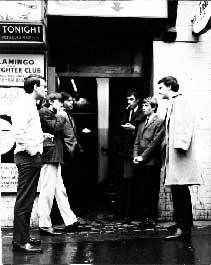
The Flamingo Club on Wardour Street in 1964
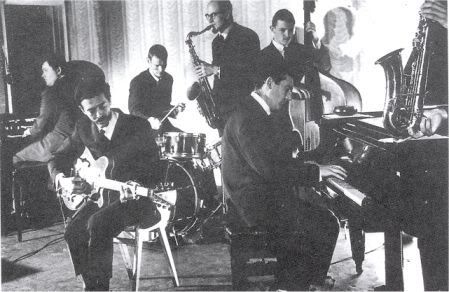
They've come down from the Cold War US airforce bases around London, where they've been playing for the servicemen - the only place up to then you could hear the blues in Britain. Like many GIs, they come into Soho, looking for entertainment. First to clubs like the Americana for jazz; then on to Wardour Street to the Barrel House and finally down to the basement club The Flamingo for modern jazz and latest r&b singles from Ray Charles and Lee Dorsey. Mixing with student trad jazz fans, being beatnik in old jumpers and scruffy trousers, the GIs cut a style in suits and ties. Some of the skifflers and jazz musicians are interested: Zoot Money, Georgie Fame And The Blue Flames, Chris Farlowe and the Thunderbirds, are listening and learning.

They interest the younger kids too. From all over London they come to hang out in Soho, young mostly working-class boys who are fascinated by everything American, but can't find it in austerity Britain, can't dress like that, but they try and put on an attitude. They are not going into National Service like their older brothers, the Teds, and coming out aged and conformist. Thanks to the self-same GIs and thanks to mutually assured destruction, the country doesn't need their services. These boys are able to go to work, earn their money, buy clothes, go out, and spend it how they want. They aren't as rich as they make out - you can do a lot on the HP. They want a new kind of life all the same.

At the Flamingo, they can meet real Americans. The GIs can sell you buttoned Levi's for a fiver.
Where do you get those suits, those shirts? They just don't exist in the high street. So you need to find a way to alter things yourself. First, find something you like at Marks & Sparks, or C&A. Round the corner from The Roaring Twenties Club, where blue beat mixes with r&b from 1961, the tailor at Newmans on North End Road will make you a suit with the 'Billy Eckstine collar', or help you get the perfect 'Italian' drop to your trouser. Go to the cinema, and there are new ideas every week. La Dolce Vita with Marcello Mastroianni, Shoot The Pianist with Charles Aznavour, Rocco And his Brothers with Alain Delon, the New Wave. Always new, different, modern, changing. Think of a style, and take it to John Stevens in Fulham, Bilgorri in Bishopsgate. Now show it off at the clubs...

It's not just about the clothes anymore. It's about the music. The GIs have records to sell as well. Better than trad jazz, or skiffle, or Cliff Richard's tame rock and roll. Its a handy extra income, and a way to offload belongings before returning to the States.

March 17th 1962.

The Barasque Club, opposite Ealing Tube Station. Art Wood, singer with Blues Incorporated, asks if the owner wants a new resident band, a blues band. He agrees. Davies and Corner open a new club night, and the faces start to appear from other pockets of London, young, fashion-conscious, a little arrogant, interested in the new sounds. Soon, another club offers them a residency - The Marquee Club, at that time on Oxford Street.

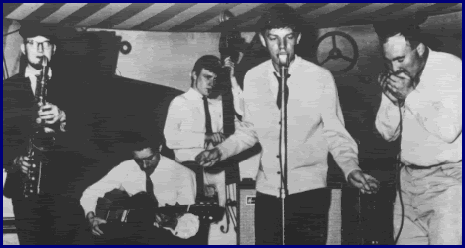
Blues Incorporated in 1963, with a young Mick Jagger having a go on vocals...Clubs in 1962 mean live music, and there are a small but growing coterie of young people who have absorbed the r&b records they have bought, and are starting to play. You'd find Brian Jones in the audience at the Marquee, Mick Jagger taking a turn as a singer with Blues Incorporated, Eric Clapton and other Yardbirds not far behind, Chris Farlowe and especially Georgie Fame and his Blue Flames turning from jazz and skiffle towards r&b at The Flamingo.

A local phenomenon amongst young men and women in London, looking for whatever the latest styles and trends are, trying to make their own identity, has encountered a club life suited to the tastes of GIs and Caribbean-Britons, and heard a music that intrigues them. Something similar is happening in some other places, in Liverpool, and in East Anglia, in smaller towns near other airforce bases. People visiting the London nightlife are bringing back the news and the new sounds to towns across the south. The rest of the country hardly know anything about it, but soon it will become a national youth culture...

Here are some tunes from Blues Incorporated in the early years. The first is taken from an LP recorded live at The Marquee Club in its first few months back in 1962, and released on Ace Of Clubs. The second is the b-side of Blues Incorporated's first single, released in 1963, many years after the formation of the group. I think this reflects the assumptions in Britain at the time that the priority for a band was playing live, and perhaps also that for many British blues musicians, they did not fully consider the idea that they could make records like their own idols. This was about to change dramatically as the recording industry, soon to be bowled over by the public fervour for The Beatles, awoke to the potential of British beat.

Alexis Korner & His Blues Incorporated - Rain Is Such A Lonesome Sound (LP 'R&B From The Marquee Club' ACL1130) 1962
Alexis Korner's & His Blues Incorporated - Please, Please, Please (B-side of Parlophone R 5206) 1963

Information gathered from The Georgie Fame site, The Marquee Club website, The British Beat Boom website (very good index of many bands), and from Mod: A Very British Phenomenon by Terry Rawlings.

Saturday, May 05, 2007

Soul Britannia: Chris Farlowe Says Baby, You're Out Of Time!

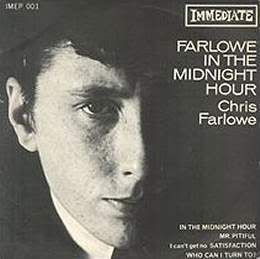
Chris Farlowe In The Midnight Hour EP 1966Its the Swinging Sixties!

As I didn't know where to start, I'll start with some of the best!

Amongst the blue eyed soul singers that emerged in the early 60s in Britain, few were as well respected as John Henry Deighton, more famously known as Chris Farlowe.

He had begun like countless other teens in the mid 50s as a skiffle fan, worshipping the grating folksiness of Lonnie Donegan and his ilk. The John Henry Skiffle Band actually won the All-England Skiffle Championship in 1957. Over the next year or so, the repertoire of the rock and roll group gravitated more and more away from rock and roll numbers towards r&b. In 1962, John renamed himself Chris Farlowe, in honour of jazz guitarist Tal Farlow (who at that time had mysteriously 'disappeared' from the jazz scene, to much debate amongst jazz cats) and the band became The Thunderbirds. They got a residency playing at the Flamingo Club in Soho, and were noticed by Decca Records. On their first single, an innocuous number called Air Travel released in November 1962, you can clearly hear the impact that a certain Sam Cooke had had on the country during that year. However, nothing came of the record.

Click Here to listen to Air Travel by Chris Farlowe And The Thunderbirds.


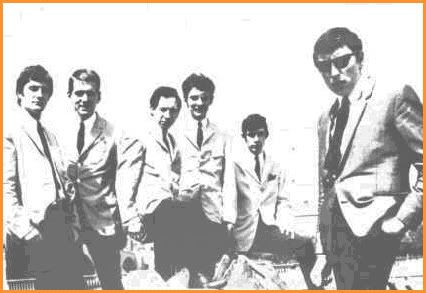
Chris Farlowe & The Thunderbirds
The band then signed a deal with EMI. They were to release a number of singles on the Columbia imprint. Despite creating some great singles the Thunderbirds were not getting hits. Ironically in 1964, when they released a single as The Beazers, called The Blue Beat, in which guitarist Albert Lee mimics the guitar strumming of ska under a conventional r&b melody, they had a dance hit. Albert, who went on to have along career as a respected guitarist across blues and country, joined the band after playing guitar with a number of bands, touring England and doing regular stints in the clubs of Hamburg. He was impressed with what he saw in the Thunderbirds, and stayed for four years:

"In May 1964, I joined Chris Farlowe and I stayed with him four years. I thought it was a great band - the best in Britain at what we did...but we never got much in the way of recognition or public acclaim. It was very frustrating; we'd support bands like The Animals, who were terribly ragged in comparison, with very little feeling or finesse - and they'd go down a storm while we got a smattering of applause from the few punters who weren't in the bar. I've got tapes of some of our gigs and they still stand up - some of our stuff was killer! Farlowe was a dynamite singer! But there was practically no crowd reaction. We worked solidly for years...tours, one nighters, all nighters, doubles, trips to Germany and Scandinavia - we went all over the place, but we never cracked it beyond a certain level."

In 1965, another class tune, Buzz With The Fuzz, was released to much mod acclaim, only to be withdrawn from sale when EMI's management realised that it might constitute a provocation towards the police.

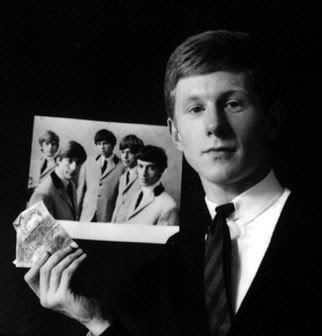
Andrew Loog OldhamThen in 1966 an offer came from Andrew Loog Oldham, manager of the Rolling Stones, who had set up a new label, Immediate Records, which was also distributed by EMI. Not only was Oldham more receptive to the sounds of r&b, he could also call on the songwriting of Jagger and Richards for his artists. Farlowe was impressed , and joined other similarly soul-inflected vocalists such as Steve Marriot of the Small Faces, and later P P Arnold, at the label.

Eric Burdon, of The Animals, was asked to produce Chris Farlowe's first two singles, and was faithful to Farlowe's r&b sentiments, though who knows what Albert Lee thought of him at the time. Some outstanding albums and EPs followed, three in 1966, starting with his showcase of soul classics, Farlowe In The Midnight Hour. Farlowe had garnered so much credibility with British fans that he and Eric Burdon were asked to appear on a special edition of the TV show Ready Steady Go! with Otis Redding.


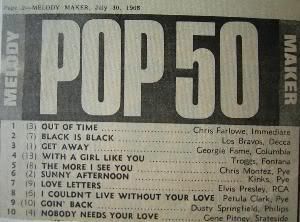
Out Of Time No.1 July 1966 It was the third single, Out Of Time, however, written and produced by Mick Jagger, that struck the right vibe, reaching Number One in July 1966. I think that while often dismissed as a Rolling Stones cover (the Stones recorded it for their album Aftermath earlier in March), and derided for its powerful orchestration, it is a wonderful Deep Soul number, in which Farlowe positively delights in giving a woman the bad news that this relationship is not just going to pick up where she left it after leaving for another man. It was so powerful it enabled England to win The World Cup!

The Beazers (Chris Farlowe & The Thunderbirds) - The Blue Beat (Decca F 11827) 1964

Chris Farlowe - Out Of Time (Immediate IM 035) 1966


Sadly, by 1967 and 1968, the cultural influences arriving in the UK were no longer dominated by soul music, and while other bands were willing and able to adapt and embrace psychedelic culture, Chris Farlowe was struggling to continue in the same r&b vein he had always championed. Despite a series of outstanding relases, the hits dried up, and he was out of a record contract in 1970. Farlowe was not eager to go down the popular cabaret singer route that others like Tom Jones opted for in these years. It must have been a blow to see Rod Stewart that same year acheive a hit with his frankly inferior version of Handbags And Gladrags, a song that had been specifically written for Chris by Mike D'Abo of Manfred Mann. Sadly, it is the Stewart version that semi-Britpoppers The Stereophonics attempted to mimic with their recent hit.

The next few years saw him join up with a number of prog rock bands as a vocalist, including Atomic Rooster and Colosseum, suffer a two year hiatus after a nasty car accident, before leaving the business temporarily in the late 70s. In the 80s, Farlowe decided to return, this time trying to tap into the adult blues market, and has made a successful new career touring solo, with his 70s band Colosseum, a reformed Thunderbirds, and with Albert Lee. So once again you can hear the voice of Chris Farlowe in the North, South, East And West (yes, this is a plug for another great Farlowe track...)

Information about Chris Farlowe from many conversations and the voluminous mod record collection of John Bennett, www.45-rpm.org.uk, and the Chris Farlowe website. Albert Lee quote from O O'Connor's fan site. Photos from the collection of Lisa and Georg, two big Farlowe fans from Germany who were once part of German beat band The Fenders. Request to hear The Blue Beat came from Blue Eyed Handsome Dad!

Soul Britannia: The Jury's Still Out There...

While perusing the internet for info about Chris Farlowe, I read this excerpt from an interview with guitarist Albert Lee. It gives a little bit of an insight into the influence of US airbases, r&b, and the Caribbean community on the beat explosion:

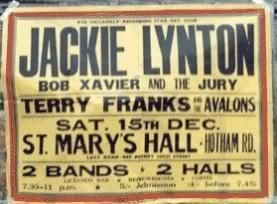
"In 1961 ... I ran into this bloke called Bob Xavier, who asked me to join his band. So I wore a variety of open necked silky shirts and worked American airbases and London clubs for over a year.

Bob Xavier was West Indian, and the band was modelled on Emile Ford and the Checkmates. Most other groups around town were still doing rock'n'roll, but we were into Drifters/Brook Benton sort of stuff...but in summer '62 Xavier left and we became the house band at the 2Is [paid 18 bob a night].

We'd play in the cofee bar 5 or 6 nights a week - backing whoever wandered onto the stage...and at weekends we would go out of town doing one-nighters backing Vince Eager, Keith Kelly and Jackie Lynton (who were all managed by Tom Littlewood - owner of the 2Is at the time)."

The band were called Bob Xavier & The Jury, and recorded a single with Jackie Lynton after Bob Xavier left. I found a picture of an old gig poster, but nothing else concerning Bob Xavier, or what he went on to do. If anybody knows anything about Bob Xavier and The Jury, I'd love to here from you!

Sunday, April 22, 2007

Hip Ship Blues: The Incredible Jimmy Smith On A Pirate Ship

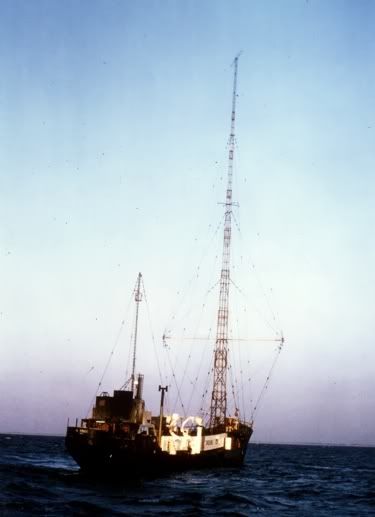
The Mi Amigo - Radio Caroline SouthRadio Caroline and the other pirate radio stations of the 1960s freed up the airwaves of a Britain sorely underserved by the offical channels of the British Broadcasting Company. First broadcasting from the MV Frederica off the coast of Essex in April 1964, outside of British territorial waters, it soon merged with Radio Atlanta, whose boat, the Mi Amigo, became Radio Caroline South, while the Frederica sailed to the Isle of Man to become Radio Caroline North, where its broadcasts were even more heavily influenced by jazz and rare blues and soul. They continued to broadcast until 1967, when offshore radio was outlawed. During that time, they transformed the musical tastes of Britain in the 1960s. Although their influence was equally as powerful for British beat and rock, they had a major influence in promoting soul music during the years 1964 and 1965.


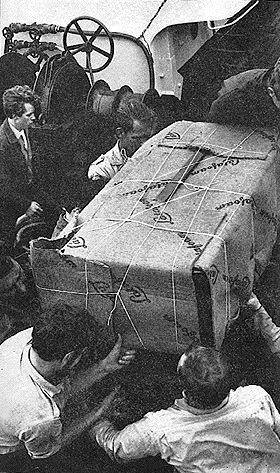
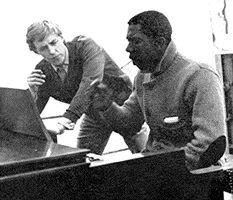
Jimmy's Hammond is brought aboard...This post recounts an unusual event from May 5th 1965 at Radio Caroline. Keen to do things differently from the BBC, the decision was made to invite renowned jazz musician Jimmy Smith aboard, who was in London to record a soundtrack for the film Where The Spies Are and to perform at the Royal Festival Hall. Jimmy brought a precious Hammond B3 organ with him, and his band, for an on-air performance live from the deck of the Mi Amigo. Simon Dee introduced them, and then Jimmy and drummer Tony Crombie, and guitarist Tony Thorne performed two tunes titled Hip Ship Blues and Satin Doll. Despite the experience of freezing on the windswept deck, Jimmy Smith also recorded several jingles that were played on Radio Caroline North. Simon Dee talking with Jimmy Smith on deck


Jimmy Smith playing in SwedenBorn in Norristown, Pennsylvania, on Dec. 8, 1925, Jimmy Smith initially learned piano at home from his father and mother, he was a prodigy and was renowned for his endless ability to improvise without repetition. After service in the war, he went on to study bass and piano at music schools in Philadelphia, despite being unable to read music - a fact his teachers never discovered! He experimented with the Hammond organ starting in 1951, but it took him until 1955 before he had finally found a sound that was distinctivey his own. He got work playing in some of New York's most famous clubs, including Cafe Bohemia and Birdland. Offered a contract with Blue Note soon after, his 1956 album New Sounds On The Organ pushed the organ as a jazz instrument. In particular, since he was not always accompanied by a bass player in his trio, Jimmy would use his knowledge of bass to play those lines himself, giving more depth to his sound, while mimicing horn players on the other hand to give it a punchy sound. The gospel tinged, bluesy style of 'soul jazz' Jimmy Smith developed was an influence on every other organist, including r&b artist Ray Charles.

In 1963, Smith left Blue Note to record for Verve. Later in life he recorded for the Concord label. He died aged 79 at his home in Scottsdale, Arizona in February 2005.

Recording made by Dick Morecraft and is available permanently at Radio London's Radio Caroline Scrapbook. Photographs from the book 'Radio Caroline' by John Venmore-Rowland. Jimmy Smith facts from report by Arthur Spiegelmann. Some good Jimmy Smith bio pages are this one by Bob Blumethal, and an interview conducted by Pete Fallico at jazzateria.com.

Soul Britannia: Just What Is It that Makes Today's Homes So Different, So Appealing?

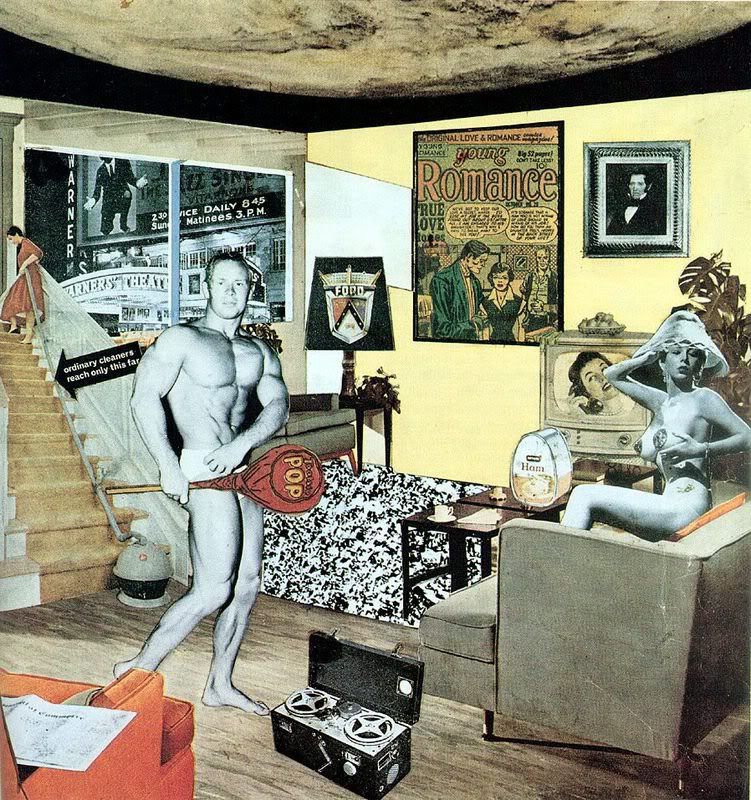
Just What Is It that Makes Todays Homes So Different, So Appealing?1956. This Is Tomorrow. Richard Hamilton presents his collage Just What Is It That Makes Today’s Homes So Different, So Appealing? Pop Art starts in Britain. Bring us America!

From Belfast to Birmingham to Newcastle, to Liverpool and back to London, Britain is emerging from the years of rationing into a more prosperous era. Full of new consumer goods and other influences from America. New musical sounds of America making their way across the Atlantic and reaching young people…

Not r&b, or even rock and roll, but skiffle at first. The music that first encouraged thousands of British youths to pick up an instrument and form a band. Lonnie Donegan and other British jazz musicians, playing a spin-off from New Orleans in the jazz era in Soho clubs. A BBC reporter investigates:

“In London, the skiffle movement provides entertainment at several dozen coffee-houses [playing] blues, ballads, shanties, work songs, country songs, cowboy songs, railway ditties and even evergreen popular tunes.”

Tune in to Saturday Skiffle Club on the BBC Light Programme on the family radio, half an hour for the teen-agers on a Saturday evening, starting in 1957. It’s the place we encountered real gospel spirituals, bluegrass, country, blues and r&b for the first time. Sometimes the authentic sound of Leadbelly on a recording. More often than not (thanks to strict rules on not allowing too much ‘needletime’ on radio), interpreted by a British skiffler in a live performance.

Skiffle sound doesn’t hold sway for long. Rock and roll hits British shores. The rechristened Saturday Club plays us more Gene Vincent, Cliff Richard, more American acts. But just half and hour still. If you want to hear some more, wait until early evening when the signal bounce is stronger off the ionosphere, sneak a transistor radio under the covers and tune into Medium Wave 208, Radio Luxembourg. They play the latest hits from the major record companies, who vied to sponsor a show to plug their products. The sound fades in and out in the south on England, but up North things are clearer…

1957: Don Lang & The Frantic Five on Six-Five SpecialTV! Neighbours rented one, it costs 10s a week from Rumbelows. Turn it on at six on Saturday and catch your favourite British rockers on Six-Five Special, Drumbeat on the BBC, or live from the Palladium on Oh Boy! on ITV. See some film clips of the American stars we wish would come to Britain.

1960. Finally, the end of the Musician’s Union ban on American performers. Finally hear Gene Vincent and Eddie Cochran, Duane Eddy and Bobby Darin, Chris Montez, Jerry Lee Lewis and Bo Diddly - performing live on Saturday Club! Finally get to see some of their rock and roll heroes in the flesh, and along with them the latest stars of soul music, a new sound, mixed with gospel music – Little Richard and Sam Cooke, at Brighton Hippodrome in 1962, Richard jumping on the piano, never been a performance like it before. Solomon Burke in 1963, Chuck Berry in 64.

Want more?

1964. Here come the pirates, broadcasting from out at sea, far away from the reach of the BBC. Radio London, Atlanta, and most of all Radio Caroline. All aboard the good ships MV Mi Amigo and the Frederica. One stays south anchored off Essex, and one goes North, carrying a cargo of several thousand rare jazz and r&b records. Now everybody can hear the new sounds of British beat, and the sounds of America, the familiar and the unfamiliar, the old and the brand new. Whatever young people are listening to in Britain, now it all originates with the music of Black America…


Information about Saturday Club is from an article by Spencer Leigh. There is a nice list of all of the artists who appeared on Saturday Club here. I read up on Six-Five Special here. Also from The Story Of Radio Luxembourg website. Radio Caroline information is everywhere on the web, I have enjoyed looking through the Radio London scrapbook on Radio Caroline, and The Pirate Radio Hall Of Fame.

Sunday, April 15, 2007

1st Anniversary: It Was A Brown Eyed Handsome Man!

It’s been a whole year since I began this blog, and I only realised this morning! I got a little writer’s block coming up with some more historical posts about soul in Britain, when I thought, why don’t I write about Chuck Berry's Brown Eyed Handsome Man?

After deciding to make a blog while not really knowing what it entailed, and discovering that every variation of ‘sweet soul music’ had been taken already, I stayed up all night watching The Buddy Holly Story on TV, where they play Buddy’s cover of this song, and in the morning the title still appealed to me. Thinking about the song and its lyrics, it seemed to evoke a lot of things about the significance of black musical forms in America. While being a ‘rock and roll’ song meant it would highlight a broader definition of rhythm and blues, that make more sense outside of the narrow genres in the racks of your local music store.

Coded language and social commentary have a long history in music, from the rhythmic patterns and drumbeats of slave songs, through the exodus and salvation imagery of revival songs and spirituals and into gospel music. In the blues, the telling of someone’s troubles in song has revealed something of the conditions of the world around them. Characters like Stag-O-Lee have lived through many decades, informing us through their fictional exploits of the desperate side of life, much in the same way as today’s hip-hop artists continue to do. Jazz followed all of these trends also, using music itself to express it.

The emergence of rockabilly and rock and roll highlighted a changing society in which the old divisions and the certainties of the folkways of segregation in America were being challenged and bypassed. In the first of the tracks featured today, you can hear four individuals challenging those changes as they struggle to get to grips with playing Brown Eyed Handsome Man at Sun Studios in Memphis in December 4th 1956. Carl Perkins, Elvis Presley, Johnny Cash and Jerry Lee Lewis. Four white boys who’d, between them, spent their youths listening to gospel in black churches, learning to play blues guitar from black musicians, grown up picking cotton on mixed farming communes thanks to the New Deal, amongst other influences. Carl Perkins, always shy and thoughtful, and a little unsure of his true talent, is clearly awestruck, as they all are, as they ponder the complexity and the wit of the lyrics, and while Elvis struggles to keep the words in rhythm. Finally, he confides earnestly to the others:

“You oughta hear some of this stuff sitting around, boy”, says Carl Perkins. “I’ve just come offa a tour with this guy, Chuck Berry. Man, he sat down behind the stage and just … man, I ain’t no good!”

Chuck Berry creates a series of entertaining, racy tale of the allure of brown-eyed handsome men and their exploits, and puts his penchant for suggestiveness to good use by this time exhorting the women to seek them out, while he of course plays the role. The race of the character is never made explicit, but is inferred by the distinctive choice of brown eyes, as opposed to the very popular ‘blue eyes’ of dozens of popular crooners’ tunes. There lies the element of social danger that was implicit in all rock and roll performed by black artists, sexual desire between races. Little Richard for example was overt about courting publicly women of all races. Chuck is going further than this, however, in his lyrics. He subverts the dominant assumptions of the era that white women were chaste, unwilling victims of ‘miscegenation’ by threading the song with the line, “Her mother told her daughter go out and find yourself …” The suggestion is that the sexual colour line was never as rigid as society’s elders wanted it to appear. Chuck tells us “Way back in history three thousand years, Back ever since the world began.” In the realm of individual relations, the reality defied the constructs of social stricture.

Roy Kasten, writing last year at the Living In Stereo blog, made a detailed appreciation of the lyrical talent of Chuck Berry, and said:

“Berry turned the sound of a sub-culture into a universal lingo and made three minute dance numbers into comprehensive portraits of life.”

How did the song story originate? According to some sources, the first verse was inspired by Berry observing a West Coast policeman trying to arrest a Hispanic man for loitering until a girl talked him out of the arrest. The second verse is alleged to be inspired by images in the sadomasochistic novel Venus In Furs. Meanwhile, in the final verse, Chuck Berry is said to celebrate the baseball player Jackie Robinson, though again, some claim that he is talking about Larry Doby, first African-American player in the American League. It is the one verse where a brown eyed handsome man is shown beyond the arena of sexuality, beating the odds and winning the game, and is an image of power.

It’s a brilliantly written tale, and elements of its lyrical techniques have influenced others such as Van Morrison with his Brown Eyed Girl. Meanwhile, in the hands of other singers, such as Nina Simone and Fontella Bass, the song gets a different treatment, as when sung from a black female perspective in the black power era, it took on connotations of a call to support black men. While this was never the original intention of the song, it certainly adds something interesting, especially since the underlying causes of alienation of black men in American society have not been addressed and have merely become worse over the decades.

Eventually, I imagine, Elvis got the hang of the lyrics.

Arrested on charges of unemployment,
he was sitting in the witness stand
The judge's wife called up the district attorney
Said you free that brown eyed man
You want your job you better free that brown eyed man

Flying across the desert in a TWA,
I saw a woman walking across the sand
She been a-walkin' thirty miles en route to Bombay.
To get a brown eyed handsome man
Her destination was a brown eyed handsome man

Way back in history three thousand years
Back every since the world began
There's been a whole lot of good women shed a tear
For a brown eyed handsome man
That's what the trouble was brown eyed handsome man

Beautiful daughter couldn't make up her mind
Between a doctor and a lawyer man
Her mother told her daughter go out and find yourself
A brown eyed handsome man
That's what your daddy is a brown eyed handsome man

Milo Venus was a beautiful lass
She had the world in the palm of her hand
But she lost both her arms in a wrestling match
To get brown eyed handsome man
She fought and won herself a brown eyed handsome man
Two, three count with nobody on
He hit a high fly into the stand
Rounding third he was headed for home
It was a brown eyed handsome man
That won the game; it was a brown eyed handsome man

The Million Dollar Quartet – Brown Eyed Handsome Man (Rehearsal Outtake) (Sun Records) Dec 4th 1956

Chuck Berry – Brown Eyed Handsome Man (1956)

Buddy Holly – Brown Eyed Handsome Man (released 1963)

Nina Simone – Brown Eyed Handsome Man (High Priestess of Soul LP, New York 1966)


Thanks To Living In Stereo blog for giving me some inspiration for this post, and they are always worth a read for descriptive and thoughtful appreciations of music. Read their Chuck Berry posts starting here. Also interesting is this account by Dave Marsh of the story of Johnny B Goode and the way society affected its lyrics: http://www.lexjansen.com/cgi-bin/marsh_xml.php?fn=2

Saturday, March 31, 2007

Soul Britannia: Soulpool

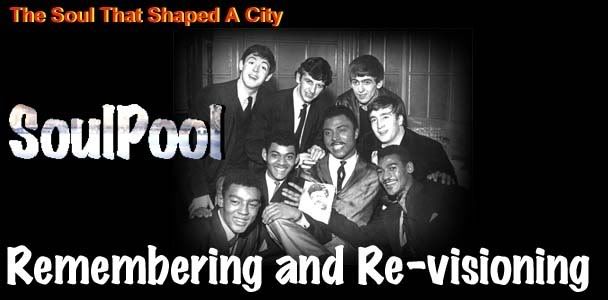
Click here to visit Soulpool! This article is based upon the remarkable research of the Soulpool website, conducted by Steve Higginson , David Pendleton and others. Basically, Soulpool is creating a detailed social and cultural history of the musical roots of Liverpool, and using oral history they have been able to present a very different version of the origins of the Mersey Sound. I don't think there is any similar project of such depth online concerning this aspect of British social history. So, once you have finished reading my short(er) post to wet your appetite, follow the links over to Soulpool to read the rest of the story that forms one of the most important chapters in the history of Soul Britannia...

Trying to track down the origin point for a social phenomenon is intrinsically difficult, and there will always be the isolated example that acts as an exception to the rule. However, the history of Merseyside offers evidence that it is amongst the earliest British communities to have ready access to and develop an appetite for American r&b music. From this appetite, a new musical movement was formed, which then went on to transform music in Britain and then impact across the world...

We will all think we know this story of course. Yet while four loveable moptops were indeed responsible for the final breakthrough of Merseybeat into popular success in 1962, their careers alone do not explain the origins of this new sound.

Liverpool's black history, of course, is a long one. Both free and unfree, black people have been living in Liverpool for 400 years. As Britain's principal slave-trading port for over a century, it surpassed Bristol and London. Even after abolition of slavery in the British Empire, Liverpool's dock workers were among the most vociferous in their support for the Confederacy during the American Civil War, being at that time dependent on the southern cotton trade. Throughout all this time and beyond to living memory, Liverpool was the principal port of access to the commerce of the Caribbean.

Poverty and casual racism often colluded to ghettoise these communities geographically, for example in Toxteth, Liverpool 8, despite the lack of racial codes. As in other areas of Britain, the sign in the window of rooms to let would frequently read, "No Irish, No Gypsies, No Blacks." However, in a busy port like Liverpool, there was work to be had in boom times, and throughout the C19th, racial solidarity could be found in workers' movements such as the Chartists (William Coffey being one of the prime leaders in London), and later in the trade union movement. Of course, in times of slump, more selfish motives could rise to the surface. Such a time occured in 1948, after a wartime rise in the black population, due to the call for qualified nurses and doctors to aid the mother nation during its time of crisis. In the post-war austerity era, it became easy for people to accuse black Liverpudlians of taking jobs that belonged to white people. White rioting occured through Toxteth in that year.

So, in Liverpool by the late 1940s, before even the Windrush generation, the black community was larger and more established than in other cities outside of the major seaports. It stands to reason that there was already a growing number of musicians with both Caribbean and African influences through the 1940s and 50s. It was however, according to oral histories, quite difficult to find venues to play in, in large part due to the long-running Musicians' Union ban on any American bands playing in unionised venues. This ban was in large part a reaction to 'negro bands', as the union put it, and affected local musicians as much when combined with the casual segregation of most Liverpool venues in the 40s and 50s. Right up until the late 1950s, most licenced clubs were folk orientated in central Liverpool. Local halls such as the Nigerian, the Sierra Leone, and the All Nations, built by the Toxteth community, or the White House pub, were some of the few opportunities to perform and to go in relative peace to hear what was still unfamiliar music to the majority of Britons.

Liverpool's position as a major seaport made it open to other influences, from the late 30s onwards. Merchant seamen who found themselves travelling to the Caribbean and to the United States had the opportunity to take shore leave and wind down in the local nightlife. They began to get a taste for the very different kinds of music they encountered there. Soon they were seeking out record stores in those places, and bringing their finds in country, jazz and later r&b home with them. To the Liverpudlians back home, these 'Cunard Yanks', as they were known, often appeared outlandish, somewhat strange, when they began to congregate and play this discover'd music at their hangouts. Their clothing would seem outlandish also, described by Cunard employee Tony Dwyer as being manily African-American fashions, such as zoot suits, full drape jackets, and very tight bottoms to the trouser leg, and which Steve Higginson describes from a slightly later era as being the smart, sharp suits and button-down shirts being worn by the American r&b artist Billy Eckstine, and uncannily similar to the 'mod' fashion that would emerge in Europe and Britain nearly six or seven years later. Some, like sailor Ian Gilmour, came home in the late 50s and established clubs in Liverpool, at least tapping into the rock and roll boom and providing a atmosphere tolerant to r&b and jazz as well as the usual rock and roll. However, some other historians strongly dispute the influence of merchant seamen on Merseybeat bands themselves, stating that it was a world in which those bands rarely interacted. As this is a big debate, I will come back to it in another post.

Record stores in Liverpool began to stock this new music in the 1950s. When the rock and roll boom hit Britain in the late 50s, there was already this established influence. Teenage skiffle enthusiasts and banjo players in Merseyside were able to satisfy their curiosity when they encountered names such as Elmore James, Sleepy John Estes, Larry Williams or Arthur Alexander alongside Elvis or Buddy Holly, in a way that other British rock and rollers would not so easily. However, there was something else that allowed the growing army of scouse rock'n roll bands to deepen their understanding and experiences of r&b.

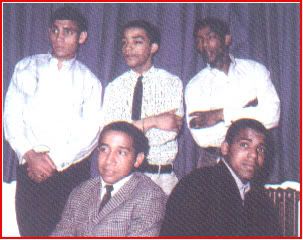
Up with rockers like Rory Storm or the Hurricanes, the Merseybeat scene was dominated byThe Chants: Joe and Eddie Ankrah, Eddie Amoo, Nat Smeda and Alan Hardin. homegrown artists playing their own authentic r&b. Derry Wilkie, Sugar Dean and Colin Areety jumped onstage when Little Richard played Liverpool, and were accepted for their talents and the enthusiasm of the local crowd. A number of big American r&b artists made it their business to tour to Liverpool, where they were assured of a good audience - one recent commentator on this blog, Bill Mitchell, remembers with fondness the time Joe Turner performed and came down into the audience during the interval to chat and have a drink with the people. The Valentinos, named for their American namesakes, and other local groups were digesting and recreating the American vocal harmony group sounds of the late 50s and early 60s. The Chants were also writing and performing in this vein. When four befringed lads came by to hear them play, they went back to their manager Brian Epstein to beg to play behind The Chants as their backing band. When The Chants came to The Cavern, this is exactly what the Beatles did, despite Epstein's obvious displeasure that his band were being upstaged.

This is how bands like The Beatles, who were also the songwriters behind hits for many other Merseybeat bands, were able to listen to complex vocal harmonies in r&b firsthand, and learn how to incorporate them into their guitar-based rock and roll.

They encouraged Brian Epstein to sign up The Chants along with many other Merseybeat bands in 1964. However, you get the impression that he had little enthusiasm for promoting them. Ironically, Epstein got them a record deal with ... Pye Records, the well-meaning but slightly out-of-their-milieu label of Jimmy James and The Vagabonds and later Geno Washington & The Ram Jam Band also. The sound of the black r&b groups of Liverpool had some similarities with the Merseybeat sound, but it is clearly pure r&b, and different enough that the record-buying public, obsessed with Beatlemania, passed it by for the next long-haired Mersey group single. Meanwhile, other enthusiasts of American r&b, in other parts of Britain, were unaware of what was on offer to them in Toxteth, in those dark days before the internet. Micks and Keiths and Erics (both Bs and Cs) continued to think they had to go to Detroit and Chicago to find the gritty r&b they had encountered.

Here is a little taste of the early Chants, written by Eddie Amoo, as would have influenced Liverpool beat groups. Later, I will be sharing some of the transformations that The Chants and other black British groups went through to try to gain commercial success to match their talents.

The Chants - I Don't Care (1963)

Information for this post came from the Soulpool website - who go into much greater detail than I have here on all these phenomena. It is a must-read if you are interested in the story of Soul Britannia! Much information about the Chants comes from articles and photos collected by Bill Harry, journalist and author of the site Mersey Beat. I have also learnt some interesting things from the websites of Colin Dilnot, who has been kind enough to mention this site several times in recent months. In Dangerous Rhythm should be part of everyone's weekly blog trail. Recently, on his Soul of Liverpool blog, Colin announced the sad passing of Vincent Ismael, a member of Liverpool soul group The Harlems.

Saturday, March 24, 2007

Soul Britannia: Geno!

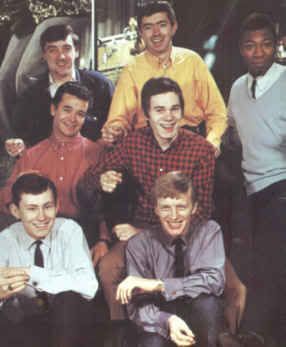
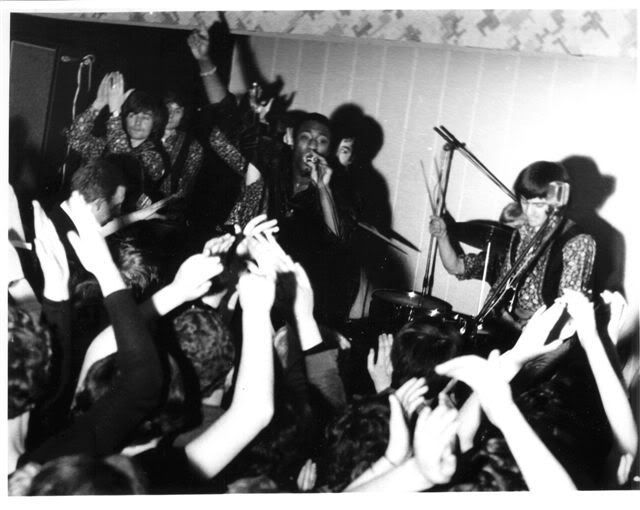
Last Friday night, I went the Komedia Bar in Brighton. Coming along also was my father (going for now by the moniker Blue Eyed Handsome Dad) for a glimpse of his Sixties past and a little generational discussion about the legacy of soul music in this island nation. And some beers. And some great soul music from an Anglophile soul man who almost single-handedly brought a live soul presence to the small towns and dance halls of East Anglia and southern England. We were waiting to see Geno Washington and The Ram Jam Band! My father remembered going to see Geno at a university hall somewhere in London back in 1967. It was with a mate of his, who he hasn't seen since the mid 60s. If you remember Dave Whatman of Auckland Drive, Bevendean, in the 60s, leave a comment!
"RAMAJAMAJAMA!"

Geno Washington, born in Evansville Indiana, is of paramount importance in the history of live soul music in Britain. How did this occur? Geno was serving in the USAF and stationed at RAF Woodbridge in Suffolk. After being demobbed, he was hanging out in local clubs in Ipswich, when he happened to go along to a gig by Shane Fenton and The Fentones. Seeing their performance convinced him that he wanted to do that too. Geno is the only soul singer to have been inspired by Fenton, read name Bernard Jewry, later to become the glam rocker Alvin Stardust. Geno admits that one of the primary motivations he had for getting into music at this time was to impress women. Travelling to London in 1965 to try his hand as a singer, he was invited to join a beat group put together by Pete Gage.

In one version told by Geno himself, the band passed by an A1 motorway service station called the Ram Jam Restaurant, and the Ram Jam Band they became… or they could simply have chosen the name from The Ram Jam Club at 390 Brixton Road where they were opening for The Animals!

From 1966, Geno Washington and the Ram Jam Band toured across southern England, performing covers of up and coming soul hits and their own material. It was a high-energy, non-stop performance, showcasing not only Geno’s powerful voice and the Ram Jam bands tight authentic sound, but also Geno’s dancing, and his humour and repartee, none of which were familiar to reserved British audiences. This was one of the few ways in which provincial soul fans were able to hear authentic soul live during that time, while waiting for the tours and revues of American soul artists. The level of touring that the Ram Jam Band put in paid off in terms of record sales, despite being signed to Pye Records, who as with The Vagabonds, did not exactly know what to do with a soul band, and initially offered Geno songs such as Que Sera Sera. Both of the Ram Jam Bands first albums, Hand Clappin’ Foot Stompin’ Funky Butt … Live! and Hipsters, Flipsters Finger Poppin’ Daddies! were recordings of their live performances. The first album, on Pye Record’s Piccadilly label, stayed on the chart for 48 weeks in 1966, becoming the third- biggest-selling album in Britain of the year. The Beatles Revolver was not even in the top three…* Finally though, in the end of the 60s, Geno decided to stop the exhausting touring, which had made the record company wealthy, but not him.

After recording back home during the 70s on and off, everything changed again in 1980. A song by Dexy’s Midnight Runners went to number one. Friends called Geno up at his home and told him: the Number One record in England, it’s about you… Geno was back out on the road, and back in the UK.

"RAMAJAMAJAMA!"
The concert is about to begin. My father mentions some ska records that come through the post addressed for me. Just then, they start playing One Step Beyond. He says that it was around 1964 when he was travelling around the West Country on a scooter that he first heard about ska, from a group of London girls they’d met. You didn’t hear it in the local Brighton clubs back then, even along at the club above the shops on Western Road next to Codrington Mansions.

Stanley ‘Wolfman’ Williams cranks out the guitar riff, then tenor Orlando Star and original baritone saxophonist Buddy Beagle punch through with the horns, and the Ram Jam Band start to Pick Up The Pieces. Then a familiar Otis Stax fanfare comes in, and Geno Washington comes on stage to wild applause and the first of many begin to leave their tables to dance at the front. Geno is singing I Can’t Turn You Loose, with his own lyrics, then segues into Wilson Pickett’s Feel It. Halfway through, he sings a dedication for tonight’s show:

“I love Elvis, I love BB King;
I love James Brown, I know he’ll be back again.”


Geno gets us hollering back lines from Land of A 1000 Dances, and gets us clapping, and then gets us dancing with Get Up Offa That Thing and exhortations to do the Funky Broadway. The call is answered by an eager crowd made up of young hipsters and potential artificial hipsters. Geno welcomes them all:

“We’re all gonna tell the truth, ain’t we? Yeah! Man, I see a lot of good looking people out there tonight. Yeah! Damn! I see a lot of damn ugly ones too! … Yeah, I remember the 60s, sorta – back in Vietnam – Major Washington – I didn’t fly jets, flew copters. And I also lie a lot!”

Geno volunteered wisely for a posting in England partly to avoid a more hazardous posting to Vietnam, and partly to further his athletics career, in which he excelled in 110m hurdles. He served as a physical training instructor.

In The Midnight Hour a lot of strange things seem to happen to Geno:

“Last night we were kidnapped by six skinhead Japanese! True. They made us drink six bottles of Jack Daniels! Bastards!”

Green Onions, accompanied by Geno's lyrics, becomes a melancholy plea, Maybe Can You Be My Baby. All the generations up on the dancefloor slow down instinctively to the strange, solitary, half turning, half shuffling gait:

“Maybe, can you be my baby?
Coz I’ve got so much love to give,
Maybe, maybe, maybe…”

and ends by pleading "Baby, please don’t go back down to New Orleans you know I love you so…"

Stevie Deuce on bass leads us into Theme From Shaft, and Geno takes that into Papa’s Got A Brand New Bag. Then a guitar string breaks, and Geno takes a little break, while letting us into a little secret he just made up:

“I made Eric Clapton’s last guitar. Looks good. He plays like shit. Four fucking licks!”

“If we get to 11, you girls might get freaky, throw knickers on stage and shit. You might, they’re just bigger now, yeah!”

Screaming Jay Hawkin’s I Put A Spell On You, in which Buddy Beagle does a particularly haunting solo, becomes a musical and comic classic in the hands of Geno. Halfway through, Geno tells us a story involving the mysterious Madame Lulabelle, a fortune teller. She tells Geno that his wife, Lula-May, is cheating on him. He can’t believe it, so he formulates a plan:

“I go home and put on Teddy Pendergrast singing Let’s Both Wax That Ass – ‘coz in my neighbourhood, if you can’t score listening to that … I’m smoking a Cuban cigar, and I’m doing my best Barry White voice to my wife – ‘Honey, was you faking it last night?’ And she says, ‘No, honey, I WAS asleep.’ Shit, it wasn’t funny too much!”

Geno challenges us to sing back the opening lines of I Feel Good, storms through the song, only to have one guy in the last pregnant pause yell out the last "I Got You!":

“Bastard (pronounced correctly with the double ‘arr’)!! Bastard! We practiced that for six months! I was even gonna do the splits, and then while I was down there, I was gonna breakdance on your ass! But HE fucked that up!”

The band back up and redo the ending, and this time, the offender gets a full dose of “Lord knows what I’d a done to yo’ mama .. yo’ sister ….”

"But that don’t make me a bad person?” asks Geno, innocently!

“Van Morrison, he used to help me out. He was the first Irishman I ever met, he always lent me 1s and 2s but never a fiver, he’s so tight his ass squeaks!”

I vow never to accept a two-pound note from Van Morrison. And on to a rousing Gloria. Everyone is shouting out the name.

“Before I got confident, I’d do that Elvis pose, with your legs wide apart. Then I’d drop my microphone and stick my ass in the air! A luxury item around here! On the street it would be ‘Can I touch it, can I rub it’ all the time. Sometimes it would be ladies too!”

The home straight is Knock On Wood, and then back into I Can’t Turn you Loose. Geno tries to go, but its back for an encore:

“I thought I’d get an easy night. Take the money and run. My lobster’s getting cold back there! Don’t you care? They paid the band in euros and steak and kidney pies.”

The band finish with Everybody Needs Somebody, as at the Soul Britannia Barbican concert in February that was barely advertised.

The concert ends slightly abruptly with a few bars of Jumpin’ Jack Flash, which just stops, just as I’m expecting a Thelma Houston style rendition.

We are left with words of wisdom:

“It is better to be pissed off than to be pissed on.”
"RAMAJAMAJAMA!"

The DJ plays out with some Dexy’s Midnight Runners, and I recall how at the end of every school disco in the early 80s, the teacher acting as DJ would play Come On Eileen, and people would ask if he could play Geno as well, although I am sure that in some part of my mind back then I though it was actually a song about Dino, the dinosaur on the Flintstones. Somewhere probably in the audience is Dexy’s songwriter and Brighton resident Kevin Rowland, though I don’t catch sight of him. Then the play the fellow Anglophile Edwin Starr’s War, and Blue Eyed Handsome Dad is intrigued to know that there is a statue in his honour in the middle of Birmingham. Next up is Nutbush City Limits, and Dad reminds me of when my brother and I would listen to this on family car outings to a country pub, roll down the windows, and literally scream out our own words: “They call it CROSSBUSH! CROSSBUSH CITY LIMITS!”, and howl with laughter, it being a tiny, sedate village near the historic town of Arundel. Another variation used to be Nutwood, home of Rupert Bear... Finally, the Temptations put us both in a Ball Of Confusion as we try to work out who is the female singer singing at the beginning. After a knockout evening of non-stop soul, we both head off for a good pub…

Geno Washington & The Ram Jam Band - If This Is Love (I'd Rather Be Lonely)
Geno Washington & The Ram Jam Band - Jumpin' Jack Flash
The first song is not on the Ram Jam Band's sixties records, but was an unreleased track now found on their compilation CD and on itunes. According to London Lee, who featured this last summer at the sadly retired No.1 Songs In Heaven blog, it was first recorded by The Precisions. It is a particularly good example of how Geno Washington helped to spread the popularity of some exceedingly rare soul recordings to the furthest reaches of Britain. The second song is here not only because these are the vocals the song should have always had to do it justice, but because we only heard ten seconds of it on the night!
Thanks to The Komedia Bar for an excellent venue and nice food. Information for this post came from various sources, including the All Music Guide, and the article If The Blues Spirit Moves You in the News & Star, who provided the humourous but perhaps apocryphal motorway service station anectdote. Thank you also to my guest the Blue Eyed Handsome Dad, Dave Whatman!

*the No.1 album of 1966 was The Sound Of Music, followed by Bridge Over Troubled Water.