Showing posts with label Chess Records. Show all posts

Monday, July 24, 2006

Billy Young: You Left The Water Running

Photobucket - Video and Image Hosting


Individuals can make a difference, and Billy Young was one of those individuals. Not only did he produce some fine southern soul records, he served his community in Macon Georgia selflessly, donating his musical talents to causes and devoting his time to work with children in need.

Billy Young began his musical career in Macon, playing the venues of Broadway such as the Two Spot, and got his first chance to record in 1961 with Glendora b/w Are You For Me.

Billy came to the notice of local legends Otis Redding and Phil Walden, who both recognised a kindred musical spirit. Billy's voice had a similar gutsy and countrified delivery, although his voice was not quite as raw or his delivery quite as strident as Otis'. Otis took Billy down to Muscle Shoals for a session at Fame Studios recording for Otis's Jotis label. The single was Do the Sloopy b/w Same Thing All Over (Jotis 469), and was distributed by Atlantic.

Billy was invited to Chess Records to record a single for them in 1966, Have Pity On Me b/w You Left the Water Running (Chess 1961).

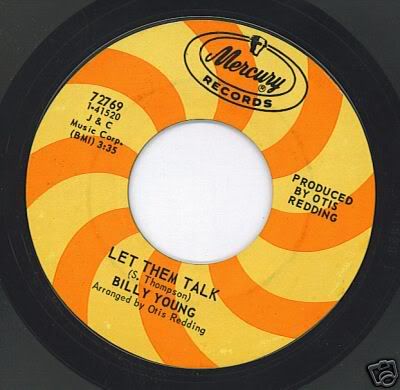
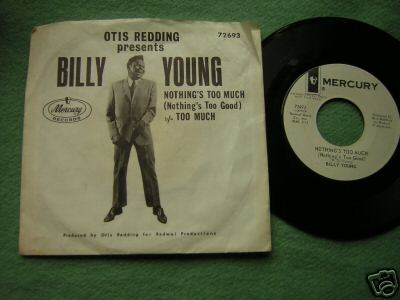
Otis Redding took Billy to record next at the Mercury label in 1966 and '67. Nothing's Too Much (Nothing's Too Good) b/w Too Much (Mercury 72693) and A Year, A Month, A Day b/w Let Them Talk (Mercury 72669) were both produced and arranged by Otis Redding, who was a conscientous mentor.
Billy Young - Nothing's Too Much (Nothing's Too Good) / Too Much

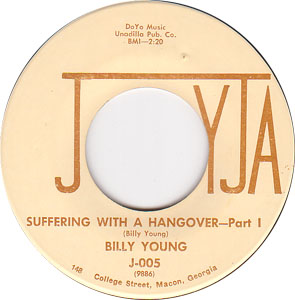
None of these singles took off nationally, but Billy continued to work through his own Joyja label(Georgia Soul! explained that this is a play on the pronunciation of Georgia out in the country), cutting songs such as Surviving With A Hangover, and the Grotto label in Macon, on which he recorded songs such as How Much Longer (Can You Hold Out) under the moniker Billy "Country Boy" Young. It was in the early 1970s that Billy began to see how he could actively contribute to the needs of his community.

Billy released a song called "Sickle Cell Anaemia" recorded purely to raise awareness among parents to have their children's blood checked, and vaccinations handled early.

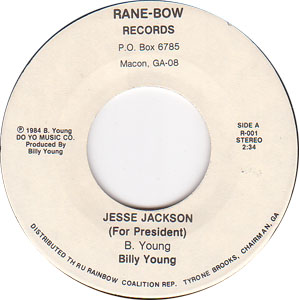
In the 1980s, Billy was involved in a local chapter of the Rev. Jesse Jackson's Rainbow Coalition. The Rainbow Coalition commissioned Billy Young to cut a single for the vanity Rane-Bow label called Jesse Jackson (For President) (Rane-Bow R-001) in 1984, but neither Jesse or the single had the success they had hoped for.

Billy Young also became a well-known figure at the Rosa Jackson Community Center working with disadvantaged children. According to the director of the center,

"The children at the center rushed to meet and hug him when he came to the center to provide active recreational outlets for them. The center staff was also overjoyed to see Mr Young on his regular visits to help provide assistance for these children. To many kids at the center he was the father they had always wished for but never had. He was instrumental in keeping them on the right path."

Billy also enjoyed writing poetry in later years, his most popular poem being one about Martin Luther King Jr, while for the children he read to regularly at the center, their favourite was titled "The Apple".

Billy Young died on 18th August 1999, but he was far from forgotten by the people of Macon. Since then, The Billy Young Memorial Tribute has been held annually at the Rosa Jackson Community Center on 1211 Maynard St, in Macon, Georgia. 31217. Over the years since this celebration started it has been attended by many city officials including members of the Macon City Council and the Mayor of Macon. The Annual Billy Young Tribute is sponsored by Reverend Frank Ray of Brothers Keeper Inc. This organization provides meals for the children who attend the Rosa Jackson Center on a daily basis. Reverend Ray also sponsors other community activities for children and young adults in and around the City of Macon, Georgia. The Rosa Jackson Center Staff co-sponsors this event every year. In 2002, the event was well attended by over 150 people.

Today's track is from Billy's Chess single, written by Dann Penn and Rick Hall, You Left All The Water Running, a reminder that sometimes, when you've got a good thing going with someone like Billy Young, you oughta stick around and appreciate things.

Billy Young - You Left All The Water Running (Chess 1961) 1966

London Lee at No1 Songs In Heaven was recently tracking down the many versions of this song, which has been sung by James & Bobby Purify, Wilson Pickett, Otis Redding, Maurice & Mac, Geno Washington, bluesman W.C. Clark, in the 90s by Dan Penn himself, numerous country singers, even Huey Lewis...

Invaluable information for this post was found from the Georgia Soul! Blog, and from the Billy Young Memorial website. Today's song is currently unavailable on CD, but Billy Young appears on several compilations such as Dave Godin's Deep Soul Treasures Vol. 1, and Lost Deep Soul Treasures Vol. 1.

Monday, April 17, 2006

Jamo Thomas: Must I Holler, Must I Let Myself Go?


Here is the first post on classic soul singers that deserves wider attention. It's Jamo Thomas, who made the journey from the Bahamas to Chicago and recorded at Chess, Decca and Thomas in the 1960s. Jamo recorded tracks such as Stop The Baby, Arrest Me, Jamo's Soul, a good version of I Spy For The FBI, Bahama Mama and Nassau Daddy, but my personal favourite is Must I Holler? It was recorded around 1966 for Chess Records, and while it is ostensibly a story of unrequited desire, it also feels like a plaintive cry of anguish that a life that looks so good is so far from the reach of African-Americans, and yet no matter how hard he tries to tell white America about the disparity, nobody is listening ...

I came across some more information about Jamo Thomas' early career in the late 50s, working with Bobby Peterson.

In 1958 Bobby teamed up with sax player Joe Pyatt, who needed a singer and key- board player for his new combo and the Bobby Peterson Quintet was born. The other members were David Butler (drums), Chico Green (bass) and Jamo Thomas (congas and bongo). They made six remarkable singles for Buddy Caldwell's Philly-based V-Tone label between 1959 and 1961, before disbanding permanently in 1962.

The band started to play in clubs with a mixed repertoire of current R&B hits, Ray Charles favourites and a few originals, when Lawrence Kerrin, a local talent scout and promoter, heard them at the Skyway Inn in southwest Philadelphia. Kerrin and Joe Pyatt collaborated writing the Quintet's first single, a simple sax/piano instrumental called The Hunch. Kerrin introduced the combo to Buddy Caldwell, who operated his new V-Tone and Len labels out of the back of his upholstery store on Ridge Avenue. The Hunch (c/w the vocal track Love You Pretty Baby) managed to climb to # 71 on Billboard's national pop charts, but a note-for-note cover by Paul Gayten on the Gordy family's embryonic Anna imprint did slightly better, peaking at # 68 in November 1959.

The quintet followed this up with a powerful two-part instrumental, Rockin' Charlie, which was used as a theme by ace deejay Jocko Henderson. They began doing one-nighters up and down the eastern seaboard, and were brought to Chicago by Buddy Caldwell to record their third single, the great Irresistible You (written by Luther Dixon), coupled with a wild instrumental, Piano Rock. "Irresistible You" went to # 15 R&B and # 96 pop in the autumn of 1960 ; Bobby Darin would record the song a year later and take it to # 15 pop. The group was now touring all over the country, with stars like Jackie Wilson, Jerry Butler and Smokey Robinson.

Been Saving My Love For You/Three Street was the fourth V-Tone single for the Bobby Peterson Quintet. Released in early 1961, it was not as strong as the first three, but still sold quite well. One Day/ Mama Get Your Hammer probably got the least airplay of all six singles. This was followed by another great instrumental, Smooth Sailin', Parts 1 & 2, which sold a fair amount. But the young musicians were already tiring of the hard road life and drummer David Butler chose to settle down and get steady work. Joe Pyatt, the real leader of the group, joined Dave "Baby" Cortez's combo as sax man in 1962, while Chico Green went on to work with Hank Ballard and the Midnighters.

Bobby Peterson himself recorded two further singles under his own name for Atlantic and Centaur, and returned to the rounds of Chester's clubs. In the 1980s he was playing in a funky aggregation called Self-Destruct.

Jamo Thomas came to Chicago during the early '60s and cut his first single Stop the Baby for the Conlo label, produced by Jerry Butler. He moved to the Sound Stage 7 label in 1965, which led to the recording of Bahama Mama in Memphis, which became a hit. In 1966, he met Eddie Thomas, Butler's former driver and now an executive with ABC-Paramount, who was starting to cut records for his own Thomas label.

In 1966, Jamo Thomas recorded I Spy For the FBI. It was recorded a couple of months after Luther Ingrams & The G-Men had recorded the original version of the song for Smash Records, but it was Jamo's version that had more success, reaching No.98 on the pop chart. Luther Ingrams has said that he believed there had been some sort of a deal between Jamo and the Impressions concerning the record, perhaps something to do with its double release on two separate labels. Jamo's version first came out on St. Lawrence Records in Chicago, before it was released on the Curtom subsidiary label Thomas. Jamo himself was based in Chicago. He worked with Monk Higgins Burgess Gardner and a host of Chicago people associated with Craig-Vee Productions, on St. Lawrence, Satellite, Sack and Thomas Records, Chess and Decca, before moving to Philadelphia, where he recorded for the Perception label, including Shake What You Brought With You and You Just Ain't Ready. Later, Jamo recorded for MCA and Nassau Records.

Jamo stopped recording his own material after 1976, but in 1979, he provided the introduction to Scream by Graham Central Station on the Star Walk album (Warner Bros.). In the 1980s he turned to gospel music and worked as an arranger for Ella Washington.

You can buy a great CD complilation of Chess hits, called Chess Club Rhythm & Soul, including Must I Holler, at www.amazon.co.uk

A CD of the Bobby Petersen Quartet was released (Relic CD 7138) in 1999 under the title "Irresistible You - Piano Rock".

Information for this article was gathered from unnamed internet sources, from message board comments by Heikki Suosalo of Soul Express magazine, and Bruce Eder of All Music Guide.