"This is what rock and roll is all about," Rock And Roll Hall of Fame President
Joel Peresman said to the coterie of music executives who had hung around after the ceremonies, eagerly hanging on to his every word.
"Who would believe that Van Halen would have to wait so long for their just reward. But lucky for them, I'm in charge now. I spent a lot of good money on hairspray, skipped class to follow their tours, and learnt three whole power chords so I could play their tunes on my 'axe' in my bedroom. Such devotion! But now the whole world understands..."Bidding his friends farewell, Mr Peresman gave final orders to security to dispose of Iggy and The Stooges. Picking up another sparkling flute of champagne, he trotted, giddily, up the steps and onto the now empty stage. It had been a good night...
... a cold draft blew threw the room. Joel span around, suddenly convinced that he was not alone. But there was nothing there, of course. How silly of me, he thought, nobody noticed. How could they possibly know what we have done? They worship who we say they should worship...
This time, he was spun around with such force he snapped the stem of the flute between his fingers. Yet the strength moving him was not his own.
I Gotcha!"No!"
You Thought I Didn't See Ya Now, Didn't Ya?"It's not possible..."
You Thought You'd Sneak By Me Now, Didn't Ya?"This can't be happening..."
Uh huh, Huh!"But they told me you only made that disco hit where you ain't gonna bump no more with no big fat woman..."
Uh huh, Huh!"Please, I didn't know..."
Now Give Me What You Promised Me, Give It Here, Come On!There was a scream, then the sound of broken glass. Then there was just the sound of running footsteps, an empty awards room, stale champagne, and a pile of gaudy trinkets...
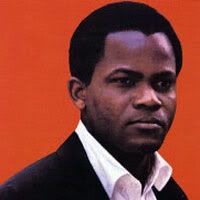
The decision to omit
Joe Tex from the
Rock And Roll Hall Of Fame this year astonishes me! How can
Van Halen have a better claim, especially in a list of candidates that also included
The Stooges as a far more credible 'rock' act? I blame MTV... Yet it continues to be the case that soul artists such as Joe Tex are all but invisible to the public at large, and their contributions to music totally ignored. Even those artists who do rise above into the collective consciousness are incompletely understood. One British tabloid (the formerly proud, campaigning, working-class
Mirror) recently described the funeral of
Mr James Brown and the public procession to view the casket as 'bizarre' and 'ghoulish' and 'grotesque'. Such commentators are in the most extreme form of denial about the origins of their popular music, yet seemingly revel in their ignorance.
The blogosphere is not immune to such frippery either. The same day as the Rock And Roll Hall Of Fame announcement,
one blog admirably featured Joe Tex and several admirable samples of his work, yet spared no expense to mock his comedic lyrical style, and even to denigrate his religion by mocking his name (termed 'El Reg Dwight' for some bizarre reason) and with numerous references to eating pork scratchings.
Yusuf Hazziez deserves better than this.
Joe's music is much deeper that the comedy on the surface suggests. There is a serious aspect to many of his songs. The comedy comes from his keen powers of observation.
Peter Guralnick puts into context the comedic aspects of Joe Tex's act in
Sweet Soul Music:
"Perhaps humor was as good a way to handle the indignities of the road as any other... Removed by twenty [now forty] years, it is not always easy to remember just how grim those days really were ... Ballparks and taxicabs are segregated ...a book about black rabbits and white rabbits was banned... A drive is on to forbid 'Negro music' on 'white' radio stations... In the face of such opposition is it any wonder that many blacks should have fallen back on 'mother wit' as their first line of defence?..."Joseph Arrington's conversion to Islam was also far from a flippant act. Many white people in the industry saw it as a sign of black activism, and thus a challenge to the established racial order of the day. In fact, it was a deeply personal search for spiritual answers, by a man who was not at all beholden to the allures of fame, and gave up his career to focus on his family and ministry. Now, of course, Joe's religion brings up other latent fears within some. How ironic that they would use comedy to protect themselves from it...
Today's song, from Joe's Dial recordings, shows the character of a man who had experienced ignorance and bigotry aplenty, yet was able to maintain his own sense of dignity and retain focus on the things close to him that meant something more...
Baby, if you be good, if you be good,If you be good, baby, if you be good,Listen!I'll give you all the love and care that your heart desiresYes I will...Listen!I've been lied on, stepped on, walked on, cheated on baby,I've still got you.I've been run down, knocked down , turned around and slapped down, babyI still got you.Listen!A man would have to be crazy, to leave a good woman like you.Coz you have got that certain little something,That makes me forget all that I've been through...I've been put out shut out, and told to stay out, and then talked about,But I've still got you.I've been beat up, cut up, shot up and told to shut up.I still got you.Listen again!A man whould have to be crazy,to leave a good woman like you,Coz you have got that certain little something,that makes me forget all that I've been through.Joe Tex - Baby, Be Good (Dial 4086) 1968Somewhere, I imagine, people who know, amongst them Buddy, Ahmet, and even James, are giving Joe a toast befitting to his contribution, and that's enough for him perhaps. And even down here, it isn't the end of the story. On October 26th 2006, someone named Phile wrote a comment in a blog elsewhere that read: "Where has Joe Tex been all my life?"
The details of the Rock And Roll Hall Of Fame inductees 2007 can be found here. To campaign for Joe Tex's inclusion in The Rock And Roll Hall Of Fame for 2008, write to: Rock and Roll Hall of Fame Foundation
1290 Avenue of the Americas
New York,
NY 10104
Or leave comments for this post, to form a petition!

 Recorded for the Night Beat album in 1963, this song has an utterly compelling quality, as, just embellished by a bass and cymbal, the lilting voice of Sam Cooke perfectly putting across the sensation of a man haunted and put to distraction by love lost.