Well, it's been a while... Life has intruded on our moments together. I didn't want it to be such a long time away from you, but a couple of weeks turned into months as work and other things took up more and more of my time. It's gotten me down more than the other problems I've been sorting out. More than once, I tried to come back to you, but each time I was pulled away. Don't be mad, don't be sad. Your brown eyed handsome man is back, here to entertain your ears, and I won't ever leave you. Let me make it up to you with some smooth talking from Joe Tex, singing a classic country track written by Willie Nelson.
Joe Tex - Funny How Time Slips Away (from Atlantic LP 'Soul Country') 1968
... Well, I am going on holiday today, but I will leave you with a bumper crop of posts to reward your patience! And until you hear The Manhattans singing Kiss And Say Goodbye on this blog, my official break-up song, believe I will return to you!
Showing posts with label Joe Tex. Show all posts
Showing posts with label Joe Tex. Show all posts
Saturday, April 05, 2008


Sunday, January 28, 2007
I've Been Put Out, Shut Out, And Told To Stay Out, And Then Talked About, But I've Still Got You: Joe Tex For The Hall Of Fame!
"This is what rock and roll is all about," Rock And Roll Hall of Fame President Joel Peresman said to the coterie of music executives who had hung around after the ceremonies, eagerly hanging on to his every word. "Who would believe that Van Halen would have to wait so long for their just reward. But lucky for them, I'm in charge now. I spent a lot of good money on hairspray, skipped class to follow their tours, and learnt three whole power chords so I could play their tunes on my 'axe' in my bedroom. Such devotion! But now the whole world understands..."
Bidding his friends farewell, Mr Peresman gave final orders to security to dispose of Iggy and The Stooges. Picking up another sparkling flute of champagne, he trotted, giddily, up the steps and onto the now empty stage. It had been a good night...
... a cold draft blew threw the room. Joel span around, suddenly convinced that he was not alone. But there was nothing there, of course. How silly of me, he thought, nobody noticed. How could they possibly know what we have done? They worship who we say they should worship...
This time, he was spun around with such force he snapped the stem of the flute between his fingers. Yet the strength moving him was not his own.
I Gotcha!
"No!"
You Thought I Didn't See Ya Now, Didn't Ya?
"It's not possible..."
You Thought You'd Sneak By Me Now, Didn't Ya?
"This can't be happening..."
Uh huh, Huh!
"But they told me you only made that disco hit where you ain't gonna bump no more with no big fat woman..."
Uh huh, Huh!
"Please, I didn't know..."
Now Give Me What You Promised Me, Give It Here, Come On!
There was a scream, then the sound of broken glass. Then there was just the sound of running footsteps, an empty awards room, stale champagne, and a pile of gaudy trinkets...
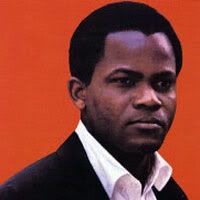
The decision to omit Joe Tex from the Rock And Roll Hall Of Fame this year astonishes me! How can Van Halen have a better claim, especially in a list of candidates that also included The Stooges as a far more credible 'rock' act? I blame MTV... Yet it continues to be the case that soul artists such as Joe Tex are all but invisible to the public at large, and their contributions to music totally ignored. Even those artists who do rise above into the collective consciousness are incompletely understood. One British tabloid (the formerly proud, campaigning, working-class Mirror) recently described the funeral of Mr James Brown and the public procession to view the casket as 'bizarre' and 'ghoulish' and 'grotesque'. Such commentators are in the most extreme form of denial about the origins of their popular music, yet seemingly revel in their ignorance.
The blogosphere is not immune to such frippery either. The same day as the Rock And Roll Hall Of Fame announcement, one blog admirably featured Joe Tex and several admirable samples of his work, yet spared no expense to mock his comedic lyrical style, and even to denigrate his religion by mocking his name (termed 'El Reg Dwight' for some bizarre reason) and with numerous references to eating pork scratchings. Yusuf Hazziez deserves better than this.
Joe's music is much deeper that the comedy on the surface suggests. There is a serious aspect to many of his songs. The comedy comes from his keen powers of observation. Peter Guralnick puts into context the comedic aspects of Joe Tex's act in Sweet Soul Music:
"Perhaps humor was as good a way to handle the indignities of the road as any other... Removed by twenty [now forty] years, it is not always easy to remember just how grim those days really were ... Ballparks and taxicabs are segregated ...a book about black rabbits and white rabbits was banned... A drive is on to forbid 'Negro music' on 'white' radio stations... In the face of such opposition is it any wonder that many blacks should have fallen back on 'mother wit' as their first line of defence?..."
Joseph Arrington's conversion to Islam was also far from a flippant act. Many white people in the industry saw it as a sign of black activism, and thus a challenge to the established racial order of the day. In fact, it was a deeply personal search for spiritual answers, by a man who was not at all beholden to the allures of fame, and gave up his career to focus on his family and ministry. Now, of course, Joe's religion brings up other latent fears within some. How ironic that they would use comedy to protect themselves from it...
Today's song, from Joe's Dial recordings, shows the character of a man who had experienced ignorance and bigotry aplenty, yet was able to maintain his own sense of dignity and retain focus on the things close to him that meant something more...
Baby, if you be good, if you be good,
If you be good, baby, if you be good,
Listen!
I'll give you all the love and care that your heart desires
Yes I will...
Listen!
I've been lied on, stepped on, walked on, cheated on baby,
I've still got you.
I've been run down, knocked down , turned around and slapped down, baby
I still got you.
Listen!
A man would have to be crazy, to leave a good woman like you.
Coz you have got that certain little something,
That makes me forget all that I've been through...
I've been put out shut out, and told to stay out, and then talked about,
But I've still got you.
I've been beat up, cut up, shot up and told to shut up.
I still got you.
Listen again!
A man whould have to be crazy,
to leave a good woman like you,
Coz you have got that certain little something,
that makes me forget all that I've been through.
Joe Tex - Baby, Be Good (Dial 4086) 1968
Somewhere, I imagine, people who know, amongst them Buddy, Ahmet, and even James, are giving Joe a toast befitting to his contribution, and that's enough for him perhaps. And even down here, it isn't the end of the story. On October 26th 2006, someone named Phile wrote a comment in a blog elsewhere that read: "Where has Joe Tex been all my life?"
The details of the Rock And Roll Hall Of Fame inductees 2007 can be found here. To campaign for Joe Tex's inclusion in The Rock And Roll Hall Of Fame for 2008, write to:
Bidding his friends farewell, Mr Peresman gave final orders to security to dispose of Iggy and The Stooges. Picking up another sparkling flute of champagne, he trotted, giddily, up the steps and onto the now empty stage. It had been a good night...
... a cold draft blew threw the room. Joel span around, suddenly convinced that he was not alone. But there was nothing there, of course. How silly of me, he thought, nobody noticed. How could they possibly know what we have done? They worship who we say they should worship...
This time, he was spun around with such force he snapped the stem of the flute between his fingers. Yet the strength moving him was not his own.
I Gotcha!
"No!"
You Thought I Didn't See Ya Now, Didn't Ya?
"It's not possible..."
You Thought You'd Sneak By Me Now, Didn't Ya?
"This can't be happening..."
Uh huh, Huh!
"But they told me you only made that disco hit where you ain't gonna bump no more with no big fat woman..."
Uh huh, Huh!
"Please, I didn't know..."
Now Give Me What You Promised Me, Give It Here, Come On!
There was a scream, then the sound of broken glass. Then there was just the sound of running footsteps, an empty awards room, stale champagne, and a pile of gaudy trinkets...
The decision to omit Joe Tex from the Rock And Roll Hall Of Fame this year astonishes me! How can Van Halen have a better claim, especially in a list of candidates that also included The Stooges as a far more credible 'rock' act? I blame MTV... Yet it continues to be the case that soul artists such as Joe Tex are all but invisible to the public at large, and their contributions to music totally ignored. Even those artists who do rise above into the collective consciousness are incompletely understood. One British tabloid (the formerly proud, campaigning, working-class Mirror) recently described the funeral of Mr James Brown and the public procession to view the casket as 'bizarre' and 'ghoulish' and 'grotesque'. Such commentators are in the most extreme form of denial about the origins of their popular music, yet seemingly revel in their ignorance.
The blogosphere is not immune to such frippery either. The same day as the Rock And Roll Hall Of Fame announcement, one blog admirably featured Joe Tex and several admirable samples of his work, yet spared no expense to mock his comedic lyrical style, and even to denigrate his religion by mocking his name (termed 'El Reg Dwight' for some bizarre reason) and with numerous references to eating pork scratchings. Yusuf Hazziez deserves better than this.
Joe's music is much deeper that the comedy on the surface suggests. There is a serious aspect to many of his songs. The comedy comes from his keen powers of observation. Peter Guralnick puts into context the comedic aspects of Joe Tex's act in Sweet Soul Music:
"Perhaps humor was as good a way to handle the indignities of the road as any other... Removed by twenty [now forty] years, it is not always easy to remember just how grim those days really were ... Ballparks and taxicabs are segregated ...a book about black rabbits and white rabbits was banned... A drive is on to forbid 'Negro music' on 'white' radio stations... In the face of such opposition is it any wonder that many blacks should have fallen back on 'mother wit' as their first line of defence?..."
Joseph Arrington's conversion to Islam was also far from a flippant act. Many white people in the industry saw it as a sign of black activism, and thus a challenge to the established racial order of the day. In fact, it was a deeply personal search for spiritual answers, by a man who was not at all beholden to the allures of fame, and gave up his career to focus on his family and ministry. Now, of course, Joe's religion brings up other latent fears within some. How ironic that they would use comedy to protect themselves from it...
Today's song, from Joe's Dial recordings, shows the character of a man who had experienced ignorance and bigotry aplenty, yet was able to maintain his own sense of dignity and retain focus on the things close to him that meant something more...
Baby, if you be good, if you be good,
If you be good, baby, if you be good,
Listen!
I'll give you all the love and care that your heart desires
Yes I will...
Listen!
I've been lied on, stepped on, walked on, cheated on baby,
I've still got you.
I've been run down, knocked down , turned around and slapped down, baby
I still got you.
Listen!
A man would have to be crazy, to leave a good woman like you.
Coz you have got that certain little something,
That makes me forget all that I've been through...
I've been put out shut out, and told to stay out, and then talked about,
But I've still got you.
I've been beat up, cut up, shot up and told to shut up.
I still got you.
Listen again!
A man whould have to be crazy,
to leave a good woman like you,
Coz you have got that certain little something,
that makes me forget all that I've been through.
Joe Tex - Baby, Be Good (Dial 4086) 1968
Somewhere, I imagine, people who know, amongst them Buddy, Ahmet, and even James, are giving Joe a toast befitting to his contribution, and that's enough for him perhaps. And even down here, it isn't the end of the story. On October 26th 2006, someone named Phile wrote a comment in a blog elsewhere that read: "Where has Joe Tex been all my life?"
The details of the Rock And Roll Hall Of Fame inductees 2007 can be found here. To campaign for Joe Tex's inclusion in The Rock And Roll Hall Of Fame for 2008, write to:
Rock and Roll Hall of Fame Foundation
1290 Avenue of the Americas
New York,
NY 10104
Or leave comments for this post, to form a petition!
Saturday, November 18, 2006
Buddy Killen: 1932 -2006
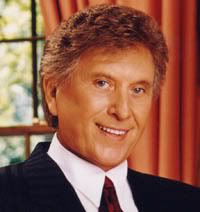
Buddy Killen, born Nov 13th 1932, Florence, Alabama; died Nov 1st 2006.
William Doyce Killen, born in Florence, not far from Muscle Shoals, moved to Nashville in 1950 aged 18 to start a career as a double bass player in the country music capital. It was here that he became involved in Tree Music, a song publishing company. In 1953, the manager of the radio station, Jack Stapp, asked him to work at his new publishing company. He would assess would-be songwriters and offer potential hits to performers. Buddy proved to be a great success.
In 1956 he was captivated when a schoolteacher, Mae Boren Axton showed him a song, Heartbreak Hotel, which he considered suitable for Elvis Presley. It established Tree Music as a major player and a grateful Stapp made Killen an executive vice-president. In the early 1960s, he discovered and recorded 15 year old Dolly Parton, before letting her leave her contract in 1964.
Killen was also a successful songwriter. In 1960, Killen wrote the US Top Ten hit Forever for the Little Dippers (an offshoot of the Anita Kerr Singers), and his compositions would include several country hits: Open Up Your Heart (for Buck Owens, 1966), I Can't Wait Any Longer (Bill Anderson, 1978), I May Never Get to Heaven (Conway Twitty, 1979), Watchin' the Girls Go By (Ronnie McDowell, 1981) and All Tied Up (Ronnie McDowell, 1986).
In 1960 he was introduced to Joe Tex. Buddy decided to move into rhythm and blues music. He admitted that he knew nothing about it when he made the decision, but it was his belief in the talent of Joe which confirmed his choice. Buddy Killen formed Dial Records in 1963, to promote Joe Tex as a recording artist. Four years of struggling to come up with a hit formula led Killen to look towards his Alabama home, and to book the Fame Studio in Muscle Shoals, to work with Rick Hall and his band. The session produced Hold What You've Got, which after Buddy had taken the reels for splicing and post-production, started a trail of hits up until Joe's retirment in 1970. They remained close friends up until Joe's death. Buddy Killen wrote Joe's comeback disco hit Ain't Gonna Bump No More (With No Big Fat Woman) in 1977.
Buddy and Tree Music continued to thrive, becoming the President and owner on Stapp's death in 1980. Eventually, in 1989, he sold the company, and set up his own agency called Killen Enterprises. He continued to work successfully with new artists such as OutKast up until his death.
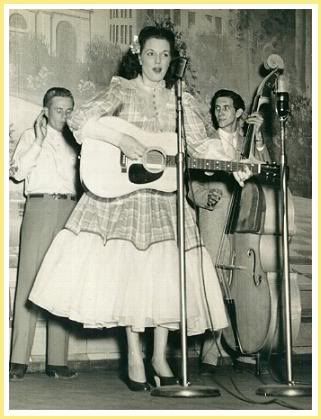
Buddy Killen & Bill Anderson - I May Never Get To Heaven (Sample)
Friday, November 10, 2006
The Commanders of The Beat!!!
Many of the Nashville r&b clubs featured house acts who might play on a weekly basis for months or years on end, when not performing out of town. Indeed there's is a street-level story of fame and musical impact rarely reflected in the charts and record sales to which music history is often reduced. Earl Gaines held forth at Nashville's Sugar Hill; Johnny Jones and the Imperial 7, or a jobbing Jimmy Hendrix with the King Kasuals, would be playing at the very popular Club Del Morocco (once frequented by Jackie Robinson and Joe Louis when they were in town.); while at Club Stealaway, Frank Howard and the Commanders, vocal trio, sang Wednesday nights from 9 until 1 in the morning.
"I never saw any of the money we made off of our records, but I made a lot of money from personal appearances. Pee Wee Johnson ran a club called the House On the Hill. We would play at the Seal-A-Way or the New Era or with Hendrix at the Del Morocco, then we would leave during the intermission and go to Pee Wee's and play there..."
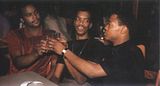
Charlie Fite, Frank Howard, Herschel Carter at Club Stealaway, in 1964, celebrating their release of their first single, Just Like Him.
Originally known as The Marquees, and originally including Frank's older brother Bruce, they had been singing around Nashville since 1957, but Frank, Charlie and Hershel grouped up in 1961. It was DJ and manager 'Hoss' Allen who renamed them The Commanders in early 1964, ready to promote their first 45, recorded at Fame Studios.
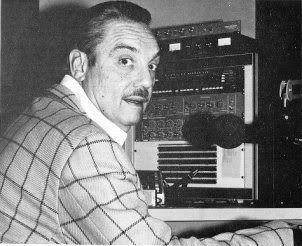
Bill "Hoss" Allen, WLAC DJ
Frank Howard had a great friendship with legendary WLAC DJ and promoter Bill ''Hoss'' Allen, who was to hire The Commanders to be regulars alongside the band of Clarence Gatemouth Brown and Johnny Jones on his r&b TV show The!!!!Beat, made in Texas but featuring Nashville musicians. However he was less happy when Allen decided to change The Commanders into Frank Howard & The Commanders...
'''Horse [Hoss] was like my brother....[but] I was very upset with my name out front. . . . But Horse said 'I want you to be out there by yourself.' Horse wanted me to be a Johnny Mathis-type singer. . . . I guess it all worked out.''
Hoss had connections and the means to promote acts like The Commanders onto a bigger stage. R&B star Earl Gaines had formed a partnership with 'Hoss' Allen in 1965. They recorded an LP, Best Of Luck To You in late 1965 to early 1966. The album featured Johnny Jones & The Imperial Seven and Frank Howard & The Commanders, and was released by HBR Records in 1966. While Earl Gaines gained the most publicity from the album, with his name prominent and scoring a No.28 r&b hit, it convinced Hoss and his backers to hire the Commanders and the Imperial Seven for the musical backbone of Allen’s syndicated television show The !!! Beat.
The cream of the Nashville r&b scene continued to flourish for a few years thanks to Night Train and The!!!!Beat, but the death of a blues club scene made it harder in the city itself. In 1967, Frank recorded a solo record, Judy, which was later covered by Al Green. After that, Frank Howard left music to pursue careers as a banker (eventually rising to senior vice president), repo man and car dealership owner.
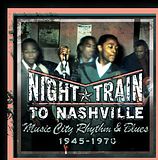
Frank Howard helped the Country Music Hall of Fame and Museum researchers with their work on the Night Train To Nashville exhibit, providing videotapes, records and reminiscences of the period. Such eyewitnesses and their oral history are all the more valuable in a rapidly changing society and urban environment, where Interstate 40 altered the landscape of north Nashville forever in the mid 1960s. Frank used to go to see Joe Tex at the Legion Club, which once stood next to the current NES headquarters:
''We would always go hear Joe when he was in town because he was a top-notch entertainer. . . . We were there when he did his first split. His pants split. We had to lend him a pair of pants so he could get back on the stage.''
Michael Gray, curator at the Country Music Hall Of Fame:
''Museums count on people like Frank. We couldn't tell the story without someone like him stepping forward and loaning us photos and artifacts.''
''I never throw anything out,'' Howard admits!
Frank Howard is now a minister at Patterson Memorial United Methodist Church in Nashville's Flat Rock, and he puts his soul into the gospel music. But he still looks back with fondness on his younger self, and was persuaded to participate in a number of r&b reunion concerts for the Night Train exhibition, which, while the participants are a little older and the audience younger, have given Nashvillians a reprise of how things used to be. Watching The Commanders slip and slide and perform flying splits while singing (You Make Me Wanna) Shout on a video, Frank says:
''Man, I was about 300 pounds lighter back then! Look at that guy!''
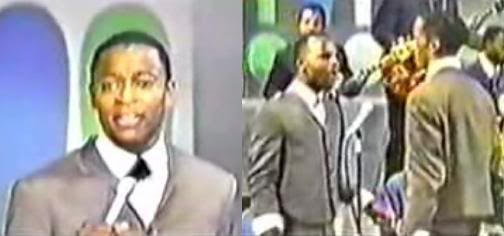
Watch The Commanders on The!!!!Beat singing I'm So Glad:
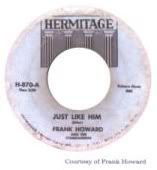
Listen to Frank Howard & The Commanders sing their first record Just Like Him:
Frank Howard & The Commanders - Just Like Him (Hermitage 870) 1964
Information and quotes taken from a fascinating interview with Frank Howard in March 2004 by Tim Ghianni at The Tennessean website. The interview is far, far longer than these excerpts, and includes lots more personal details and insights...
Other information from the Night Train To Nashville exhibit booklet. Photographs from the personal collection of Frank Howard. Archive of The!!!!Beat provided by innercalm. Mp3 link hosted by Commotion PR, Night Train To Nashville public relations. You can buy the CD Night Train To Nashville at this link...
"I never saw any of the money we made off of our records, but I made a lot of money from personal appearances. Pee Wee Johnson ran a club called the House On the Hill. We would play at the Seal-A-Way or the New Era or with Hendrix at the Del Morocco, then we would leave during the intermission and go to Pee Wee's and play there..."
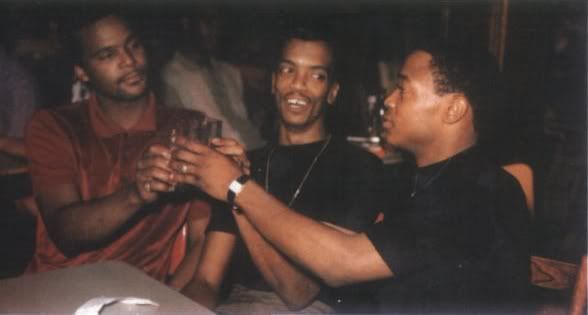
Charlie Fite, Frank Howard, Herschel Carter at Club Stealaway, in 1964, celebrating their release of their first single, Just Like Him.
Originally known as The Marquees, and originally including Frank's older brother Bruce, they had been singing around Nashville since 1957, but Frank, Charlie and Hershel grouped up in 1961. It was DJ and manager 'Hoss' Allen who renamed them The Commanders in early 1964, ready to promote their first 45, recorded at Fame Studios.
Bill "Hoss" Allen, WLAC DJ
Frank Howard had a great friendship with legendary WLAC DJ and promoter Bill ''Hoss'' Allen, who was to hire The Commanders to be regulars alongside the band of Clarence Gatemouth Brown and Johnny Jones on his r&b TV show The!!!!Beat, made in Texas but featuring Nashville musicians. However he was less happy when Allen decided to change The Commanders into Frank Howard & The Commanders...
'''Horse [Hoss] was like my brother....[but] I was very upset with my name out front. . . . But Horse said 'I want you to be out there by yourself.' Horse wanted me to be a Johnny Mathis-type singer. . . . I guess it all worked out.''
Hoss had connections and the means to promote acts like The Commanders onto a bigger stage. R&B star Earl Gaines had formed a partnership with 'Hoss' Allen in 1965. They recorded an LP, Best Of Luck To You in late 1965 to early 1966. The album featured Johnny Jones & The Imperial Seven and Frank Howard & The Commanders, and was released by HBR Records in 1966. While Earl Gaines gained the most publicity from the album, with his name prominent and scoring a No.28 r&b hit, it convinced Hoss and his backers to hire the Commanders and the Imperial Seven for the musical backbone of Allen’s syndicated television show The !!! Beat.
The cream of the Nashville r&b scene continued to flourish for a few years thanks to Night Train and The!!!!Beat, but the death of a blues club scene made it harder in the city itself. In 1967, Frank recorded a solo record, Judy, which was later covered by Al Green. After that, Frank Howard left music to pursue careers as a banker (eventually rising to senior vice president), repo man and car dealership owner.
Frank Howard helped the Country Music Hall of Fame and Museum researchers with their work on the Night Train To Nashville exhibit, providing videotapes, records and reminiscences of the period. Such eyewitnesses and their oral history are all the more valuable in a rapidly changing society and urban environment, where Interstate 40 altered the landscape of north Nashville forever in the mid 1960s. Frank used to go to see Joe Tex at the Legion Club, which once stood next to the current NES headquarters:
''We would always go hear Joe when he was in town because he was a top-notch entertainer. . . . We were there when he did his first split. His pants split. We had to lend him a pair of pants so he could get back on the stage.''
Michael Gray, curator at the Country Music Hall Of Fame:
''Museums count on people like Frank. We couldn't tell the story without someone like him stepping forward and loaning us photos and artifacts.''
''I never throw anything out,'' Howard admits!
Frank Howard is now a minister at Patterson Memorial United Methodist Church in Nashville's Flat Rock, and he puts his soul into the gospel music. But he still looks back with fondness on his younger self, and was persuaded to participate in a number of r&b reunion concerts for the Night Train exhibition, which, while the participants are a little older and the audience younger, have given Nashvillians a reprise of how things used to be. Watching The Commanders slip and slide and perform flying splits while singing (You Make Me Wanna) Shout on a video, Frank says:
''Man, I was about 300 pounds lighter back then! Look at that guy!''
Watch The Commanders on The!!!!Beat singing I'm So Glad:
Listen to Frank Howard & The Commanders sing their first record Just Like Him:
Frank Howard & The Commanders - Just Like Him (Hermitage 870) 1964
Information and quotes taken from a fascinating interview with Frank Howard in March 2004 by Tim Ghianni at The Tennessean website. The interview is far, far longer than these excerpts, and includes lots more personal details and insights...
Other information from the Night Train To Nashville exhibit booklet. Photographs from the personal collection of Frank Howard. Archive of The!!!!Beat provided by innercalm. Mp3 link hosted by Commotion PR, Night Train To Nashville public relations. You can buy the CD Night Train To Nashville at this link...
Saturday, June 24, 2006
Interview With Johnny Williams Part 3: Making Music...
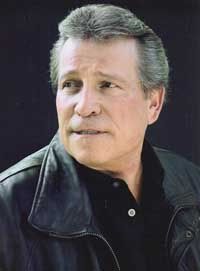
This is the third installment of the interview with Johnny Williams, a musician with a long career from playing guitar with Joe Tex, to learning his chops with Henry "Blue Boy" Hubbard, to leading his own bands and performing for over 40 years. Click on the links above to read the other installments...
Back to the early 1970s, and Johnny Williams, having studied at the feet of bluesman H L Hubbard, initially considered a military career. After finishing his stint with the Air Force, Johnny returned to Baytown. One night a friend took him to the most popular club in Houston, Dome Shadows, and had the bandleader call Williams up to sing a few songs. Neither knew it happened to be the last night for the featured vocalist. The band offered him the job. Johnny didn't know the band, The Jokers, also had a recording contract with Pic 1 Records. At 23, recording as Johnny Williams & The Jokers, he recorded Long Black Veil, a song first sung by Lefty Frizzle, and made popular by Johnny Cash, as a flipside to the song Dearest Darling. They also recorded some other tracks such as Won't You Forgive. The all-night DJ at KILT flipped it over. It became a runaway local No.1 hit.
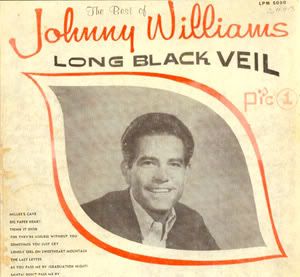
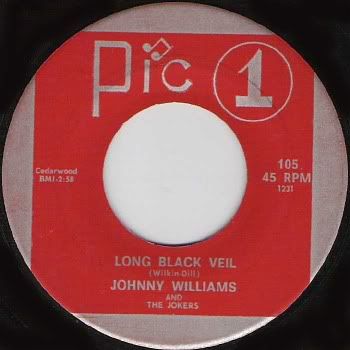
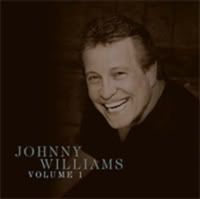
Johnny recorded his most recent album in late 2004, released in 2005, titled Volume One. It gave Johnny the chance to select some of the best musicians in Houston, Texas, and a chance for a musical reunion with his old friend Mickey Gilley, bandleader, singer and club owner during the 1970s.
"All entertainers, I'm sure, will tell you there was a time during their career when they felt like giving up ... twice in my career when I faced that crossroad Mickey Gilley gave me an opportunity ... to keep pursuing my dream..."
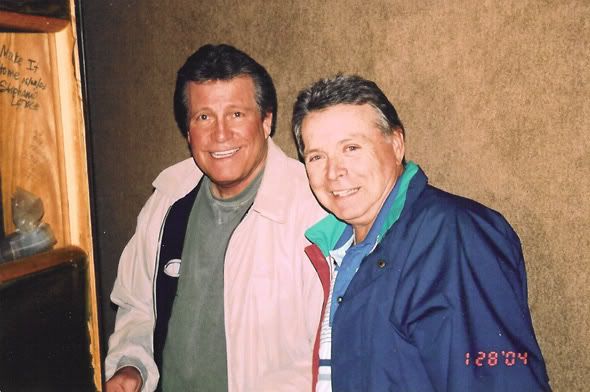
Leaving the Dome Shadows band, Williams went to work with Mickey Gilley at the Nesadel club in Pasadena, Texas. Gilley would sing the first 30 minutes of a set with his band. Mickey, incidentally, once recorded with producer Lelan Rogers (brother of Kenny Rogers), who also helped produce Esther Phillips' country soul classic Release Me (a No.1 r&b hit). As featured singer Williams would follow with 15 minutes, backed up by Gilley. When Williams left the Nesadel, Johnny Lee, a future country star, took his place.
"If I had stayed with Gilley I might have been in Urban Cowboy [the film, starring John Travolta, which showcased country music in a similar way to how Saturday Night Fever did for disco, and filmed at Gilley's club] and recorded a song for the album. Johnny Lee has never thanked me for giving up my job at the Nesadel! ... That old Nesadel band was one of the best bands I ever worked with and performing at the Nesadel and at Gilley's was some of the most fun I've ever had..."
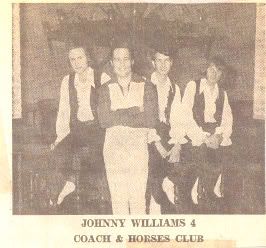
Johnny formed the The Johnny Williams Four, later the Johnny Williams Band, playing in clubs in Houston and across the region. It was one of the first bands in town doing dance music with a horn section and a "mellotron" which sounded like real strings. Johnny explained to me the reason behind this unusual range of instruments:
"I wasn’t doing any country when I had that band. When doing songs like Frankenstein by Edgar Winter, psychedelic instruments (mini moog) came in real handy. And when I did ballads that required strings the melletron was the only instrument at that time that sounded like strings. With horns, a moog synthesizer and a melletron there really wasn’t anything we couldn’t do."
Johnny's band were capable of playing across every style of music, from r&b, country, blues, pop, rock, and rock n'roll. Playing as a house band at a club for long regular stints had great advantages and for Johnny, much more fun, than touring:
"If you’re not the lead act, I don’t really see any advantages, maybe getting an education by travelling to so many different places. When I was travelling with Mickey Gilley, long after I had a hit record I couldn’t stand being on the road. Not much fun!"
Johnny recorded for Epic Records, working with the songwriter Mickey Newbury and Johnny Cash's former keyboard player Larry Butler as producer. He nearly secured another crossover hit with the song He'll Break Your Heart.
The advent of disco and the rise of the DJ greatly changed the club scene, and bands like Johnny's were less in demand, and found it harder to find places to play. Johnny stopped touring and performed at Gilley's Club for four years, which by now was a mecca for country fans from all over Texas, and received airplay on over 500 stations thanks to the weekly "Live From Gilley's" show. In 1989, Johnny decided to retire from music.
Ironically, the last decade has seen a revival of interest in authentic local music scenes and real musicians, once considered buried under MTV. After 12 years away from music, Johnny took up his guitar and plugged in the Hammond B3 for another recording session. His new album brings all of his experience together, and alot of influences. Johnny wanted to explain the unique musical circumstances his generation of musicans have encountered:
"Let me say that I think that I was born in a very special and unique era of time. I guess that would be a good way to put it. I like to preface everything I say with the words “in my opinion,” so let me start out by saying that in my opinion the way music and my generation came together will never happen again. Let me explain. Most of the music that we hear today was not handed down to my generation from another generation. I live through the birth of every genre of most of the music we hear today. I was there during the birth so to speak. Consequently my taste in music was nurtured by all genres of music, from one end of the spectrum to the other which included everything from big bands to heavy metal. I’ve been influenced by all kinds of music and all kinds of artist."
What were your earliest musical memories?
"I started really getting into music when I was about five or six years old. At that time I listened to whatever was popular. My first memories were listening to Glenn Miller, Hank Williams Sr, Patti Page, and Tennessee Ernie Ford. Then from the age of about twelve to fourteen I started listening to blues or more appropriately Bbop, i. e., The Drifters, Lloyd Price etc. Then Elvis and Jerry Lee came into my life when I was about 16. From there you have to factor in everything that’s happened since then to the present. I’ve listened to it all. Growing up I was exposed to so many different kinds of music it would be impossible to zero in on any one kind. Today I’m almost totally and exclusively a jazz listener. That’s just about all I listen to, not the New Orleans jazz but true jazz, Oscar Peterson, Charlie Bird, and all the new jazz artists that have come along. I’m not much on fusion but other than that it’s mostly jazz."
Who are your favourite Hammond organ players?
"There are so many. Jimmy Smith, Jimmy McGriff, Brother Jack McDuff, Joey DeFrancesco, Tony Monaco just to mention a few."
White and black musicians, in all different parts of the South, seem to find a lot of common ground between country and rnb. Is this something you also find? Do you have any thoughts on why this occurs?
"I think it comes together because of the driving rhythm. [Like r&b music]... Country music today has a good hard driving beat."
Where do you think southern American music will go in the future?
"I don’t really know but I worry because black artists aren’t picking up the blues. I worry because nobody is learning to play the B3 and nobody seems to be interested in learning how to play the blues. I really don’t care for popular chart music today, rap, hip-hop etc. However, as long as people will accept crap it will be financially profitable to dispense it."
Many bands, especially in Britain, have tried to pick up the musical styles of the South. There are even some country-noir influenced bands in Brighton. Can it be truly taken up elsewhere in the world, where it wasn't 'born'?
"... my own recordings reflect my eclectic taste ... I will probably cover the gamut of all genres on my CDs, country ballads, pop, blues, rock n’ roll, soul... I don’t think good music and especially music that makes people want to dance has any language or cultural barriers."
Many thanks to Johnny Williams for all of his recollections. You can buy Johnny Williams' latest album by visiting his website store here. You can listen to clips from the Urban Cowboy soundtrack at this page at Amazon.com. Mickey Gilley sings the Ben E. King classic Stand By Me, and Here Comes The Hurt Again. For an interesting recollection of what Gilley's country music club was like in the 1970s and 1980s when Johnny was a staple act, go to Mickey Gilley's website.
Monday, June 19, 2006
Interview With Johnny Williams Part 2: East Austin Blues
This is the second part of the interview with Johnny Williams, the r&b musician from Texas. In Part One, Johnny described growing up next door to Joe Tex, and his introduction to the music scene playing guitar for a stint in Joe's band. In this section, we find out more about the important blues scene of East Austin, and his friendship with blues guitarist Henry "Blues Boy" Hubbard.
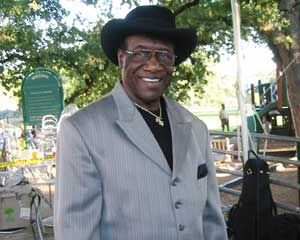
Johnny went to study at the University of Texas in Austin in the early 1960s, and soon became intrigued by the blues music scene of the East Side. How did Johnny's family take his decision to become a musician?
"They didn’t like it until I had a hit record and started getting popular. Then they were all for it. My father wanted me to be a lawyer."
It was on visits to the East Side clubs that Johnny would meet his other musical mentor, H.L. Hubbard. Henry "Blues Boy" Hubbard had been playing through the 1950s with his house band The Jets:
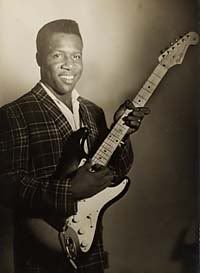
"The Jets were the house band at Charlie’s Playhouse there in Austin, Texas where everybody went to dance. It was practically the only club in town that had good live blues. At that time in my eyes they were wonderful. However, I was a novice when I met H. L. I don’t know how I would judge them today now that I’ve got about 40 years experience under my belt but at the time I thought they hung the moon, I just about worshipped H. L.
He introduced me to jazz and the Hammond B3, which, along with the piano, is still my favorite instrument. I'd wait until he got off around midnight and go eat barbecue and then listen to music, or he'd teach me guitar until the sun came up."
H.L. and Johnny are still great friends, and talk on the phone or visit on a regular basis.
Another young blues fan of the time was Allen "Sugar Bear" Black. Similarly impressed by his experiences, he still works at Antones House of Blues in the district. Interviewed by the Austin Chronicle, he recalled:
"I was a youngster in 1965, going to Charlie's Playhouse. I saw bands like Al 'TNT' Braggs, Tyrone Davis, and Albert Collins, but mostly it was Blues Boy Hubbard and his Jets on the weekends. It was basically a Blue Monday club for blacks, but on Friday and Saturday nights, it was 95% white -- kids from colleges and the University of Texas. It was real unusual to have that. They didn't fear coming to the Eastside; people didn't get their cars vandalized, stuff like that. More like it is now, with blacks and whites in clubs together."
The Austin Chronicle also interviewed Henry Hubbard himself. He thinks that there were some economic benefits to this growing scene:
"Charlie's brought the white kids from the west side and the runoff enabled the other clubs to have a heck of a business. Like Sam's Showcase on 12th Street and the IL Club across the corner from Charlie's Playhouse. And when Charlie's was full, the kids just said, 'We'll go to the IL Club,' because he had a band, too. They just tore that club down a year or two ago."
Other clubs in Eastside Austin during the 60s were the Derby, Good Daddy's, the Victory Grill, and Ernie's Chicken Shack, a popular after-hours bar that would host blues music into the early hours. Henry Hubbard would be influential to numerous other blues artists who joined his band, including Big Pete Pearson, W.C. Clark, Matthew Robinson and trumpeter Donald 'Duck' Jennings.
Sadly, from the mid-seventies,the customers who had sustained the Eastside blues performers were looking for new sounds and new entertainments, elsewhere in the city. Venues closed down en masse, or transformed to try to meet new tastes. H.L. Hubbard described the situation for the r&b artists:
"The club owners kept coming and going. Get a band to a club for a year, someone else buys the club, maybe he don't want a band."
In recent years, several local initiatives have worked hard to collect, preserve, and pass on the heritage of the East Austin blues scene, while the area around 11th Street is providing more and more venues for blues music. And Henry Blues Boy Hubbard is still going strong as a part of that scene. Johnny Williams will be pleased to hear that:
"Musically speaking, I give him credit for what I am today. He introduced me to jazz and jazz artists that I would probably not have found on my own. For that I’m forever thankful to him. For my definition of soul he is a very soulful person and I think a lot of that rubbed off on me."
Johnny thanks Hubbard again in the dedication for his new album "Johnny Williams Volume 1":
"Thank you for your patience, your friendship, and all those lessons in the wee hours of the morning after you had already performed all night at Charlie's, not to mention the great BBQ at 2:00 in the morning. The time we spend together is profoundly enjoyable, and I hope there will be many more opportunities in the years to come."
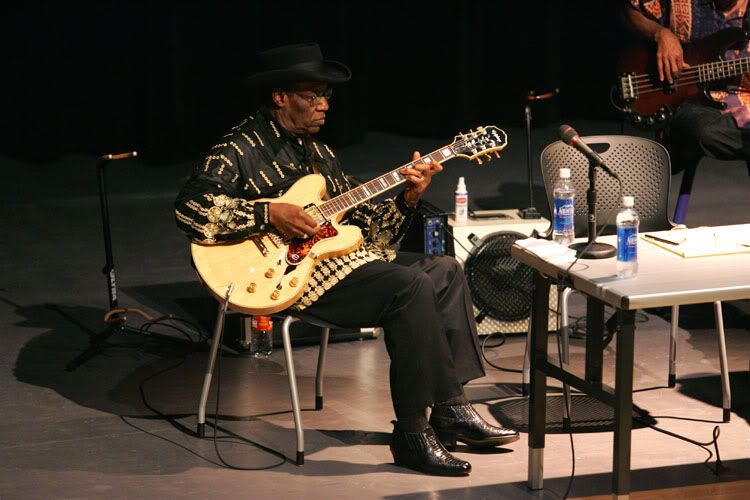
Watch a video clip of Henry Blues Boy Hubbard performing "Everyday I Have The Blues" with the Texas Eastside Kings here
If you live in Austin, see them play live today, 19th June, at the Central Market at 6pm, admission free!
You can buy their new CD at Dialtone Records.
Information about Austin blues is being archived at three locations: at the KLRU website as part of their links on the PBS TV series "The Blues", at the Blues Society of Austin, and at the Blues Family Tree Project website.
Many thanks to Johnny Williams for his recollections. Other quotes taken from interviews conducted by Margaret Moser. For the full story of the East Side Blues scene, read the whole article at the Austin Chronicle.
Sunday, June 18, 2006
Juneteenth!
When I was very young, I heard the original rapper, Joe Tex, say these words:
"Reminds me of a time up in Navasota, Texas, eatin' barbeque an' drinking red soda water on the 19th of June ..."
I loved the syncopation. But what did it mean? I had no idea, but used to (still do) sing it over and over, like a mantra! Then one day, I discovered what every Texan knows, and what Joe is talking about. Tomorrow is Juneteenth!
For those outside the USA, I'll give some background to this celebration. On January 1st 1863, as part of his efforts to bolster a war effort that seemed to be in danger of stagnating or even turning against the Union, President Abraham Lincoln published the Emancipation Proclamation. The moment had not been ideal, but with the Confederate advances at least halted at the Battle of Antietam, he was unlikely to have a more propitious moment. Not fully converted himself to the concept of black equality, Lincoln was nonetheless now convinced of the important military role that black Americans could play, and Emancipation of slaves in territories taken back from the Confederacy was the means to harness that new source of fighting men for the Union cause. Perhaps he would allow black soldiers the right to vote after the war, he mused...
The Proclamation itself did not free a single person that day - it only applied to slaves in territory captured in the future, so not to people in places like Tennessee that had already been recaptured, or to the slave-owning Border states that had remained politically loyal to the Union. Nor was it the first opportunity for slaves to take freedom in the war: slaves had been crossing the lines on their own initiative since early on, and at Fortress Monroe, Virginia, overwhelmed by the numbers of black men and women making their way to his command, General Benjamin Butler gave it his sanction by dubbing the free men and woman 'contraband of war' and refusing to hand them back to their former masters. In fact, he had received some considerable pressure from Lincoln himself to abandon this unauthorised policy...
But over the next two years the Proclamation began to have its effect as Grant and Sherman's armies made their progress through the South. Rumours concerning the Emancipation Proclamation began to circulate amongst southern slaves, and more were encouraged to take their freedom. Many made their way to the North to enlist as Union soldiers.
One part of the Confederacy lingered on for a few months after all the rest had capitulated - Texas. On 19th June 1865, General Gordon Granger read out General Order No.3, which announced the Emancipation Proclamation in Galveston. At that time, approximately 250,000 slaves resided in the state. From this date, they were slaves no more. Yet, still, slavery would persist in Kentucky and the other Border States until the passage of the 13th Amendment.
Celebration amongst black Texans went on for days. However, would the Union guarantee them civil or political rights? Would they be able to play an active role in the Reconstruction of their state? In the first few years after 1865, there were positive signs, black office-holding was achieved; black sheriffs, black mayor in Donaldsonville, Louisiana, black members of state legislature, black congressmen Joseph Rainey, and black senator Hiram Rhodes Revels.
But by 1883, only John Lynch remained as an elected member of Congress. Gradually, after 1876, new alliances of southern whites began to form, and in the 1890s, not even the black-white solidarity that had helped buttress the Farmers' Union and Populist movement could prevent to imposition of new 'jim crow' laws and segregation espoused by new Democrat demagogues who fused issues of the southern white poor with racialism.
Yet throughout these years, celebrations of June 19th continued, dubbed Emancipation Day in those times, particularly in Texas, Louisiana, and the black-belt districts of Oklahoma and Arkansas. Black leaders in Houston purchased land for an Emancipation Park in 1872, and a similar thing happened in Austin in 1906. It was even condoned by the segregationist administrations, in certain places allowing black Americans entry to white-only leisure facilities for the day. There is some debate as to whether the form and conventions of 'Juneteenth', as it became know in the 1920s, was being manipulated to depoliticise it.
Despite, or because of this, the celebration survived, and after the changes of the civil rights movement in the 1950s and 1960s, it began to gain greater recognition. Texas made Juneteenth an official holiday in 1980, and the President blesses the event as a 'special day'. This year, events are being held in at least a dozen countries. It has developed into a celebration of the meaning of freedom, and a day of remembrance for those who had it taken from them. It is as important today to think of those things as back in 1865.
Ok, enough history lessons for today - get some friends and family together, make yourselves comfortable, cherish each other, tell stories and sing songs, open up some strawberry soda and share some good food. Who better to get us in a party mood than Joe? Meanwhile, the Zion Harmonizers do a wonderful rendition of the song which has become the anthem of this day.
Joe Tex - Men Are Gettin' Scarce (Dial 45-4063) 1968
The Zion Harmonizers - Lift Every Voice And Sing (Mardi Gras Records) 1993
Find out about how Lift Every Voice And Sing was written by listening to this NPR report by Dave Person. You can find out more about the song at NPR: At The Creation.
More information about Juneteenth can be found at the official Juneteenth website, along with ideas for celebrating and information about events across the USA and other countries. www.AfriGeneas.com also has in-depth information about Juneteenth and other African-American heritage.
The inspiring Professor Ira Berlin has organised a Juneteenth photo article at the Oxford University African-American Studies Centre website.
Find more versions of Lift Every Voice And Sing listed at http://creativefolk.com/blackhistory/lift.html. The Women of The Calabash do a great version.
Further historical details in this article provided from the seminars of Prof. Eric Foner, and by Dr Adam Smith of University College London. Also, the ghost of Mary Lincoln has visited me in a spiritual vision (well, the comments section, anyway) to remind me that I had written Declaration instead of Proclamation all through this post!...
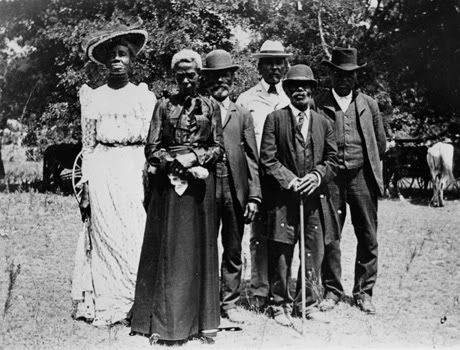
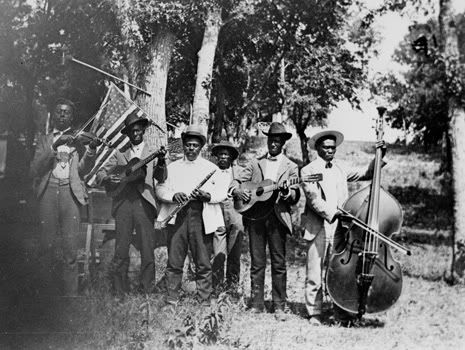
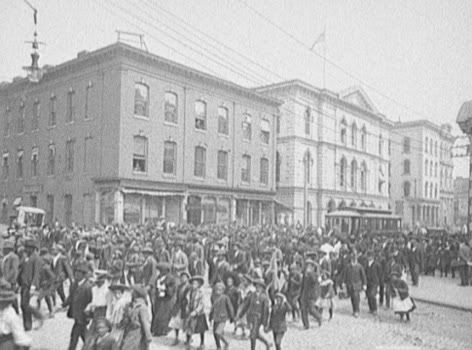
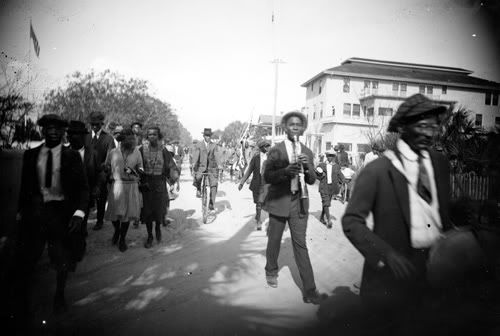
Historical Juneteenth photographs, from Florida and Austin Texas c. 1900-1905
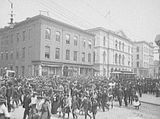
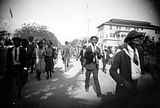
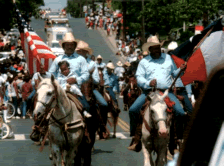
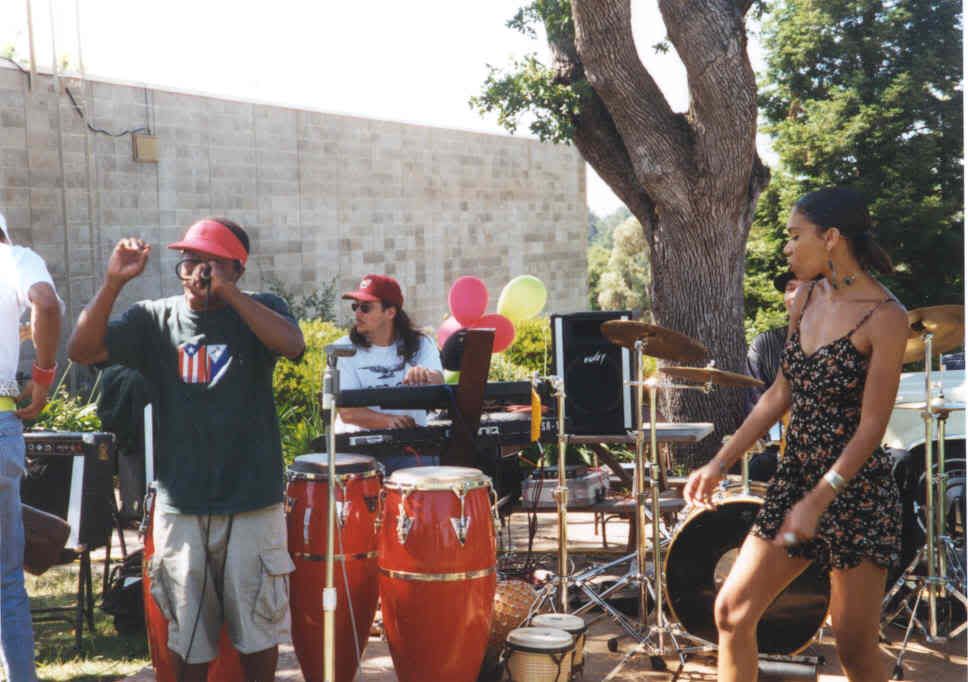
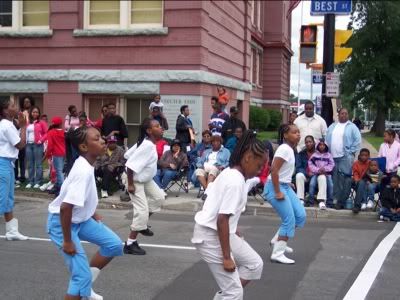
Contemporary celebrations of Juneteenth
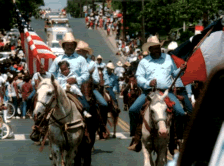

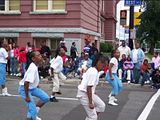

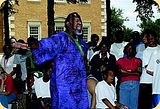
"Reminds me of a time up in Navasota, Texas, eatin' barbeque an' drinking red soda water on the 19th of June ..."
I loved the syncopation. But what did it mean? I had no idea, but used to (still do) sing it over and over, like a mantra! Then one day, I discovered what every Texan knows, and what Joe is talking about. Tomorrow is Juneteenth!
For those outside the USA, I'll give some background to this celebration. On January 1st 1863, as part of his efforts to bolster a war effort that seemed to be in danger of stagnating or even turning against the Union, President Abraham Lincoln published the Emancipation Proclamation. The moment had not been ideal, but with the Confederate advances at least halted at the Battle of Antietam, he was unlikely to have a more propitious moment. Not fully converted himself to the concept of black equality, Lincoln was nonetheless now convinced of the important military role that black Americans could play, and Emancipation of slaves in territories taken back from the Confederacy was the means to harness that new source of fighting men for the Union cause. Perhaps he would allow black soldiers the right to vote after the war, he mused...
The Proclamation itself did not free a single person that day - it only applied to slaves in territory captured in the future, so not to people in places like Tennessee that had already been recaptured, or to the slave-owning Border states that had remained politically loyal to the Union. Nor was it the first opportunity for slaves to take freedom in the war: slaves had been crossing the lines on their own initiative since early on, and at Fortress Monroe, Virginia, overwhelmed by the numbers of black men and women making their way to his command, General Benjamin Butler gave it his sanction by dubbing the free men and woman 'contraband of war' and refusing to hand them back to their former masters. In fact, he had received some considerable pressure from Lincoln himself to abandon this unauthorised policy...
But over the next two years the Proclamation began to have its effect as Grant and Sherman's armies made their progress through the South. Rumours concerning the Emancipation Proclamation began to circulate amongst southern slaves, and more were encouraged to take their freedom. Many made their way to the North to enlist as Union soldiers.
One part of the Confederacy lingered on for a few months after all the rest had capitulated - Texas. On 19th June 1865, General Gordon Granger read out General Order No.3, which announced the Emancipation Proclamation in Galveston. At that time, approximately 250,000 slaves resided in the state. From this date, they were slaves no more. Yet, still, slavery would persist in Kentucky and the other Border States until the passage of the 13th Amendment.
Celebration amongst black Texans went on for days. However, would the Union guarantee them civil or political rights? Would they be able to play an active role in the Reconstruction of their state? In the first few years after 1865, there were positive signs, black office-holding was achieved; black sheriffs, black mayor in Donaldsonville, Louisiana, black members of state legislature, black congressmen Joseph Rainey, and black senator Hiram Rhodes Revels.
But by 1883, only John Lynch remained as an elected member of Congress. Gradually, after 1876, new alliances of southern whites began to form, and in the 1890s, not even the black-white solidarity that had helped buttress the Farmers' Union and Populist movement could prevent to imposition of new 'jim crow' laws and segregation espoused by new Democrat demagogues who fused issues of the southern white poor with racialism.
Yet throughout these years, celebrations of June 19th continued, dubbed Emancipation Day in those times, particularly in Texas, Louisiana, and the black-belt districts of Oklahoma and Arkansas. Black leaders in Houston purchased land for an Emancipation Park in 1872, and a similar thing happened in Austin in 1906. It was even condoned by the segregationist administrations, in certain places allowing black Americans entry to white-only leisure facilities for the day. There is some debate as to whether the form and conventions of 'Juneteenth', as it became know in the 1920s, was being manipulated to depoliticise it.
Despite, or because of this, the celebration survived, and after the changes of the civil rights movement in the 1950s and 1960s, it began to gain greater recognition. Texas made Juneteenth an official holiday in 1980, and the President blesses the event as a 'special day'. This year, events are being held in at least a dozen countries. It has developed into a celebration of the meaning of freedom, and a day of remembrance for those who had it taken from them. It is as important today to think of those things as back in 1865.
Ok, enough history lessons for today - get some friends and family together, make yourselves comfortable, cherish each other, tell stories and sing songs, open up some strawberry soda and share some good food. Who better to get us in a party mood than Joe? Meanwhile, the Zion Harmonizers do a wonderful rendition of the song which has become the anthem of this day.
Joe Tex - Men Are Gettin' Scarce (Dial 45-4063) 1968
The Zion Harmonizers - Lift Every Voice And Sing (Mardi Gras Records) 1993
Find out about how Lift Every Voice And Sing was written by listening to this NPR report by Dave Person. You can find out more about the song at NPR: At The Creation.
More information about Juneteenth can be found at the official Juneteenth website, along with ideas for celebrating and information about events across the USA and other countries. www.AfriGeneas.com also has in-depth information about Juneteenth and other African-American heritage.
The inspiring Professor Ira Berlin has organised a Juneteenth photo article at the Oxford University African-American Studies Centre website.
Find more versions of Lift Every Voice And Sing listed at http://creativefolk.com/blackhistory/lift.html. The Women of The Calabash do a great version.
Further historical details in this article provided from the seminars of Prof. Eric Foner, and by Dr Adam Smith of University College London. Also, the ghost of Mary Lincoln has visited me in a spiritual vision (well, the comments section, anyway) to remind me that I had written Declaration instead of Proclamation all through this post!...
Contemporary celebrations of Juneteenth
Friday, June 16, 2006
Interview: Johnny Williams remembers Joe Tex
We are going back to Soul Country, but this time we have a guide to show the way...
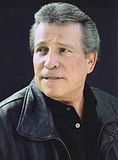
Johnny Williams has played in blues, country, soul, rock, r&b, and jazz veins, building up regular followings in clubs in his native Texas during the 1970s, and is best known for his hit single Long Black Veil. He now writes and records.
Johnny very kindly agreed to answer a few questions about his career, and how he came to meet, work, and be influenced by his friends and mentors Joe Tex and Austin bluesman Henry "Blue Boy" Hubbard.
In this part of the interview, Johnny Williams describes how he came to meet Joe Arrington Jr, or Joe Tex.
He didn't have far to go - Johnny actually grew up next door to Joe, his first major musical influence:
"Joe's mother, Cherry Sue, was a maid for the couple who lived next door to my house. They were one of the more affluent families that lived in Baytown at that time. It may have been called Goose Creek at that time. I can't remember what year the name was changed from Goose Creek to Baytown. They, the Sanders owned Culpepper Furniture Company. Anyway they had living quarters for their help and Cherry Sue lived there on the premises. Actually the maid's quarters was attached to the house. Joe would periodically stay there with his mother and that's when I met him and go to know him. I don't know exactly how old I was but I could not have been much older than 12, 13 or 14 years old...
...When we were very young - he was 4 to 5 years older - we played lots of games, mostly some kind of ball games. I heard a lot of his songs and ideas as I was growing up. He would come by our house when he was in jr. high, entertain us by singing, playing the piano and telling jokes. Joe was extremely funny. He entertained all of Baytown while in high school."
Joe's father left when he was young. I wondered what Joe's mother, was like:
"Real loving and real sweet and Joe idolized her."
Baytown is now a suburb of Houston, but back in the late 50s, it was still a small town, originally called Goose Creek. Johnny remembers what it was like to grow up there:
"When Joe and I grew up in Baytown the population was around 30,000 people. We hung out mostly in pool halls, drive-in hamburger joints, and going to dances at school sponsored hangouts. We had a dance hall called the Quack Shack because our school mascot was a gander. However when Joe and I were growing up, Baytown was not integrated. Joe went to Carver High, a totally black school. Joe and I were long gone from Baytown when they finally integrated the school district."
I asked Johnny whether there was much interaction between black and white people in the town, or was his friendship with Joe quite rare?
"It was very rare. Blacks still had to sit in the back of the bus, couldn’t eat in white restaurants and had there own public drinking fountain."
Did Johnny remember any particular songs that Joe would play to him, or that he would spin on the radio?
"I don’t remember any particular song or songs. The only things I do remember are some of the little sayings that he later injected into his recordings. For example, if we were playing baseball and Joe hit a homerun he might touch home plate and say, “If Grandma could see me now.” I later heard him say that on one of his recordings. Joe was a natural born comedian and he would perform for 2 or 2,000 people. It would all depend on his mood. And he was moody. Joe was a thinker. He was a philosopher and he started writing a book before he got famous. I don’t know whatever happened to that book but I think the injustice of racism bothered him profoundly."
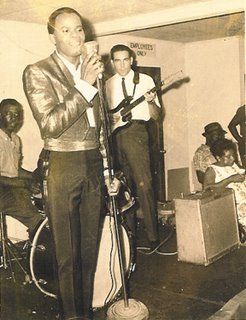 While studying at the University of Texas, Williams hung around with Joe, who by then was periodically working the Austin music scene...
"Before he made it big, we played a lot of small towns in that area. He didn't really need me in his band but I would go with him and play what little guitar I knew. When he wasn't performing we would spend hours together at his motel listening to music, hanging out and just having fun. He would stay in Austin 2 or 3 weeks; leave; return 6 months later and we'd do it again. My first trip to Nashville was because of Joe ... Joe Tex was a huge influence and I learned a great deal from him."
I asked Johnny how he got on with the band and life on tour:
"I remember Joe’s band, and you’ve got to keep in mind that this was before he got famous, as being extremely irresponsible. That was the antithesis of Joe’s personality. He would get so irritated with them. They would show up for a TV performance or a gig and forget to bring guitar picks and usually didn’t say anything about it until it was time to go on. Joe was not like that. He was extremely responsible. He had his act together. But again that was before he made it big. I never worked with him after he had his first hit which was Hold On To What You’ve Got."
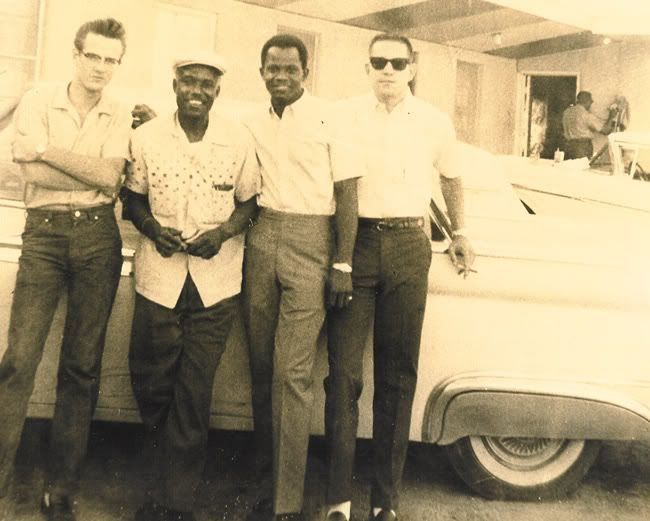
I wondered whether there had been any problems working in a racially-integrated band at that time:
"I only had a problem one time and that was in Taylor, Texas. I got put in jail ostensibly for drinking a beer after hours. At that time you could not drink beer after twelve midnight. I wasn’t drinking. I was using it to put ashes in. I was smoking a cigar. However, when I got put in the squad car the first thing they asked me was, “What are you doing hanging out with a bunch of niggers. That was the real reason I got put in jail. Joe came and bailed me out. I was only in there for a couple of hours. Other than that one instance, I never had a problem. I was living in Austin, Texas at the time and it was extremely integrated when it came to clubs and music. There was a place called Charlie’s Playhouse where all the university kids went to dance and it was integrated. I never saw a problem there. The blacks were extremely friendly. There was no sixth street at that time."
What was the best moment of that first tour for you?
"Appearing with George Jones on George Jones Day in Beaumont, Texas was probably the first big thrill I experienced when I went on tour. George took me to his house and I got to hang out with him and his band. That was exciting at the time."
I asked what Johnny remembers about Joe the most?
"How gifted he was as an entertainer, how magnetic he was, how friendly he was and how much talent he had in so many ways. He was truly a remarkable person...
... Joe was one of the best entertainers I’ve ever seen. He was a true entertainer, a Sammy Davis type. He entertained the people, with comedy, dancing and music. He was fabulous in my eyes. Joe could have been a great stand-up comedian. He was magnetic. He had that intangible quality that people gravitate towards...
...We remained friends until he died at age 49. The last time I saw Joe I played in a foursome in an Austin golf tournament with him, my sister Marian, and Darryl Royal. At that time Joe suggested I record some of his songs. I've recorded two and plan to do more. "
Johnny Williams has recorded a couple of Joe's songs, You Got What It Takes and I Want To (Do Everything For You), on his new CD Johnny Williams: Volume One , which is available to buy at Johnny Williams online store. Check out the sample streams at his website or at CD Baby.
Brown Eyed Handsome Man would like to thank Johnny Williams for his time and for the fascinating memories that he has shared in this interview. Invaluable information and photos kindly provided by Johnny Williams himself, and with permission from the Johnny Williams' website.
Johnny Williams has played in blues, country, soul, rock, r&b, and jazz veins, building up regular followings in clubs in his native Texas during the 1970s, and is best known for his hit single Long Black Veil. He now writes and records.
Johnny very kindly agreed to answer a few questions about his career, and how he came to meet, work, and be influenced by his friends and mentors Joe Tex and Austin bluesman Henry "Blue Boy" Hubbard.
In this part of the interview, Johnny Williams describes how he came to meet Joe Arrington Jr, or Joe Tex.
He didn't have far to go - Johnny actually grew up next door to Joe, his first major musical influence:
"Joe's mother, Cherry Sue, was a maid for the couple who lived next door to my house. They were one of the more affluent families that lived in Baytown at that time. It may have been called Goose Creek at that time. I can't remember what year the name was changed from Goose Creek to Baytown. They, the Sanders owned Culpepper Furniture Company. Anyway they had living quarters for their help and Cherry Sue lived there on the premises. Actually the maid's quarters was attached to the house. Joe would periodically stay there with his mother and that's when I met him and go to know him. I don't know exactly how old I was but I could not have been much older than 12, 13 or 14 years old...
...When we were very young - he was 4 to 5 years older - we played lots of games, mostly some kind of ball games. I heard a lot of his songs and ideas as I was growing up. He would come by our house when he was in jr. high, entertain us by singing, playing the piano and telling jokes. Joe was extremely funny. He entertained all of Baytown while in high school."
Joe's father left when he was young. I wondered what Joe's mother, was like:
"Real loving and real sweet and Joe idolized her."
Baytown is now a suburb of Houston, but back in the late 50s, it was still a small town, originally called Goose Creek. Johnny remembers what it was like to grow up there:
"When Joe and I grew up in Baytown the population was around 30,000 people. We hung out mostly in pool halls, drive-in hamburger joints, and going to dances at school sponsored hangouts. We had a dance hall called the Quack Shack because our school mascot was a gander. However when Joe and I were growing up, Baytown was not integrated. Joe went to Carver High, a totally black school. Joe and I were long gone from Baytown when they finally integrated the school district."
I asked Johnny whether there was much interaction between black and white people in the town, or was his friendship with Joe quite rare?
"It was very rare. Blacks still had to sit in the back of the bus, couldn’t eat in white restaurants and had there own public drinking fountain."
Did Johnny remember any particular songs that Joe would play to him, or that he would spin on the radio?
"I don’t remember any particular song or songs. The only things I do remember are some of the little sayings that he later injected into his recordings. For example, if we were playing baseball and Joe hit a homerun he might touch home plate and say, “If Grandma could see me now.” I later heard him say that on one of his recordings. Joe was a natural born comedian and he would perform for 2 or 2,000 people. It would all depend on his mood. And he was moody. Joe was a thinker. He was a philosopher and he started writing a book before he got famous. I don’t know whatever happened to that book but I think the injustice of racism bothered him profoundly."
What were the major hang outs for young people in the town, and what venues were there to encounter music?
"We encountered music everywhere. The radio and jukeboxes mostly but they did have concerts in Houston at the Houston Coliseum. There we could catch all the popular acts at the time, James Brown, Johnny Ace, The Spiders, whoever was hot at the time. When I got into music and had my first hit record, Long Black Veil, I made appearances there from time to time with other acts like Johnny Winter, Roy Head, B.J. Thomas, Kenny Rogers, Mickey Gilley, all the well-known artist from this area. One interesting note: When I was growing up in Baytown at that time there were only two people in the entire city that owned a guitar. When I came back from college, there were about 5 kids on my block that owned guitars."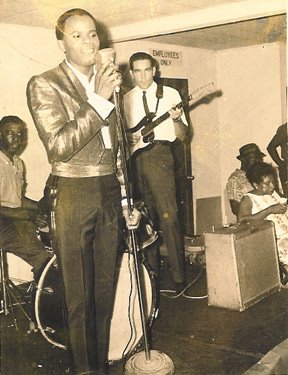 While studying at the University of Texas, Williams hung around with Joe, who by then was periodically working the Austin music scene...
"Before he made it big, we played a lot of small towns in that area. He didn't really need me in his band but I would go with him and play what little guitar I knew. When he wasn't performing we would spend hours together at his motel listening to music, hanging out and just having fun. He would stay in Austin 2 or 3 weeks; leave; return 6 months later and we'd do it again. My first trip to Nashville was because of Joe ... Joe Tex was a huge influence and I learned a great deal from him."
I asked Johnny how he got on with the band and life on tour:
"I remember Joe’s band, and you’ve got to keep in mind that this was before he got famous, as being extremely irresponsible. That was the antithesis of Joe’s personality. He would get so irritated with them. They would show up for a TV performance or a gig and forget to bring guitar picks and usually didn’t say anything about it until it was time to go on. Joe was not like that. He was extremely responsible. He had his act together. But again that was before he made it big. I never worked with him after he had his first hit which was Hold On To What You’ve Got."
I wondered whether there had been any problems working in a racially-integrated band at that time:
"I only had a problem one time and that was in Taylor, Texas. I got put in jail ostensibly for drinking a beer after hours. At that time you could not drink beer after twelve midnight. I wasn’t drinking. I was using it to put ashes in. I was smoking a cigar. However, when I got put in the squad car the first thing they asked me was, “What are you doing hanging out with a bunch of niggers. That was the real reason I got put in jail. Joe came and bailed me out. I was only in there for a couple of hours. Other than that one instance, I never had a problem. I was living in Austin, Texas at the time and it was extremely integrated when it came to clubs and music. There was a place called Charlie’s Playhouse where all the university kids went to dance and it was integrated. I never saw a problem there. The blacks were extremely friendly. There was no sixth street at that time."
What was the best moment of that first tour for you?
"Appearing with George Jones on George Jones Day in Beaumont, Texas was probably the first big thrill I experienced when I went on tour. George took me to his house and I got to hang out with him and his band. That was exciting at the time."
I asked what Johnny remembers about Joe the most?
"How gifted he was as an entertainer, how magnetic he was, how friendly he was and how much talent he had in so many ways. He was truly a remarkable person...
... Joe was one of the best entertainers I’ve ever seen. He was a true entertainer, a Sammy Davis type. He entertained the people, with comedy, dancing and music. He was fabulous in my eyes. Joe could have been a great stand-up comedian. He was magnetic. He had that intangible quality that people gravitate towards...
...We remained friends until he died at age 49. The last time I saw Joe I played in a foursome in an Austin golf tournament with him, my sister Marian, and Darryl Royal. At that time Joe suggested I record some of his songs. I've recorded two and plan to do more. "
Johnny Williams has recorded a couple of Joe's songs, You Got What It Takes and I Want To (Do Everything For You), on his new CD Johnny Williams: Volume One , which is available to buy at Johnny Williams online store. Check out the sample streams at his website or at CD Baby.
Brown Eyed Handsome Man would like to thank Johnny Williams for his time and for the fascinating memories that he has shared in this interview. Invaluable information and photos kindly provided by Johnny Williams himself, and with permission from the Johnny Williams' website.
Wednesday, June 07, 2006
Soul Country: Joe Tex
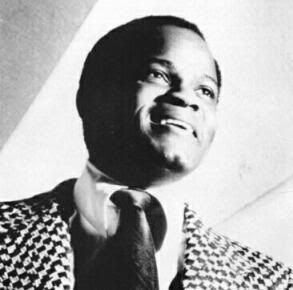
Yusef Hazziez, born Joseph Arrington Jr, better known as Joe Tex, was a pivotal figure in the development of southern soul music. His contribution has often been underrated, appropriated or simply ignored, as Joe often claimed in his frequent on-stage and off-stage battles with James Brown for the title of Soul Brother No. 1. Joe played a vital part in linking country music with gospel and blues in the new ‘soul’ form of r&b (in a more unified manner than Ray Charles’ renditions of country tunes). Later on, Joe would influence funk and the vocal cadences of rap. When Peter Guralnick offered up the monicker ‘clown prince of soul’, attempting to highlight Joe’s good humour and positive approach to the music, he inadvertently skewed the way in which Joe Tex’s music would be judged for many years.
In this post, I’ll bring together some of the events of Joe’s early life and career, to show how country music and rhythm & blues influences developed in his music…
The son of Joseph Arrington, Sr., and Cherie Jackson, Joe was born at Rogers, Texas, on August 8, 1935. He moved to Baytown at age five with his mother after her divorce from his father and attended school there. While Joe attended the segregated G W Carver School, his neighbourhood contained both black people and working-class whites. To drum up custom for his shoeshining and paper round, Joe performed song and dance routines for neighbours, performing rhythm & blues and country songs, while trialing his own compositions. He also sang in the school choir and the McGowen Temple church choir. In the evenings, Joe worked at KREL Radio in Baytown, as Jivin’ Joe, alongside country-orientated disc-jockeys such as Cowboy Dickie Rosenfeld. Joe was playing the songs of black acts such as the Spiders, Lloyd Price and Johnny Ace alongside songs by Hank Williams… Joe had imbibed a variety of musical influences from gospel and blues, doo-wop, rock n’roll and country.
During his junior year of high school, Joe entered a talent search at a Houston nightclub. He took first prize over such performers as Johnny Nash, Hubert Laws, and Ben E. King-imitator Acquilla Cartwright. He performed a skit called "It's In the Book" and won $300 and a week's stay at the Hotel Teresa in Harlem. There, Arrington performed at the Apollo Theater. During a four-week period he won the Amateur Night competition four times(allegedly being told not to come back again...)
After graduating from high school in 1955, he returned to New York City to pursue a music career. While working odd jobs, including caretaking at a Jewish cemetery, he met talent scout Arthur Prysock, who paved the way for him to meet record-company executive Henry Glover and get his first record contract with King Records in 1955.
At King Records, Joe felt that he was in the shadow of their bigger artists Hank Ballard, Little Willie John, and especially James Brown. Joe claimed that he wrote Willie John’s hit Fever, and that, struggling with debts, he had sold the tune to Otis Blackwell, something that Blackwell denies. Joe recorded a number of humourous songs such as Davey You Upset My Home and Pneumonia, more out of a need to prove he could make money as a songwriter for the company. He moved to Ace Records in New Orleans in 1957, But again, as an artist he was encouraged to focus on comedy songs, mimicking Little Richard and Fats Domino. Joe was looking for a new start, to develop his own style. His songwriting here was later recognized when James Brown covered his tune Baby, You’re Right in 1961 and scored a No. 2 r&b hit.
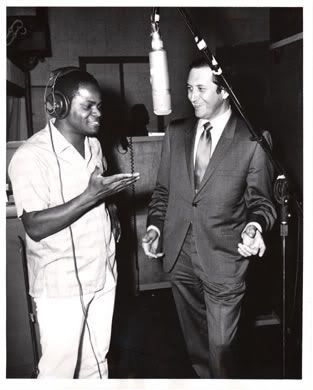
Buddy Killen, a former bass player at the Grand Ole Opry, saw Joe Tex in Nashville and was amazed by his performance skills. He signed Joe up to his new Dial Records in 1961, and in a way, due to his inexperience with rhythm and blues, he allowed Joe the space to develop his music. Killen said in an interview with Barney Hoskyns:
“Out of just trying to expand my horizons a little, I started signing black writers and artists…I didn’t know anything about r&b…but it slowly rubbed off on me…”
At first, Joe focused on gospel-influenced ballads, with songs such as Meet Me In Church. They didn’t make much impact, and Killen went with Joe down to the little-used Fame Studio in Muscle Shoals, Killen's hometown, in 1964. Killen recalls the night of Nov 6th 1964:
“We’d worked seven hours on a song called ‘Fresh Out Of Tears’ … I suggested to Joe that we try a couple of lines from this new song he’d written, using straight country chords …”
The recording did not go smoothly, Joe complaining at one point “Man, I don’t know nothing about harmony!”, and Buddy having to overdub and splice the best takes together, but the finished record, Hold What You’ve Got, was a new form of country-tinged southern soul, more raw and less church-based than Solomon Burke's Just Out Of Reach. It reached No. 5 on the pop charts, the first soul record ever to do so. According to Joe in an interview with Gerri Hershey in 1982:
“You wanna know my secret for getting a cross-over hit? I used the same formula every time – half soul musicians, half country.”
Of the Fame musicians that day, drummer Roger Hawkins had toured with Cousin Wilbur, Grand Ole Opry comedian; Albert 'Junior' Lowe on bass was a country player;Kelso Hurston returned from Nashville to play guitar on the track.
Within the song were influences that in particular would guarantee its success amongst the record-buying public in Texas and Louisiana. Catherine Yronwode has noticed the similarities of Joe’s song to the "swamp pop" ballads of Louisiana music, as performed by Cookie & The Cupcakes and others. The piano style of Ronnie Wilkins was perhaps influenced by this. Indeed, some sources claim that Joe developed much of the ‘rap’ in the heart of song while performing Etta James’ All I Could Do Was Cry in Baton Rouge, and performing in that city may have given him some musical ideas.
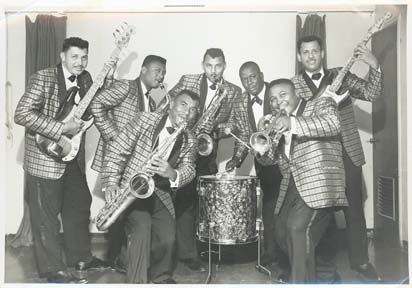
Joe’s phrasing was also extraordinary, combining the earnestness of southern preaching with playfulness, and incorporating a talking rhythm that has been likened to traditional African story-telling techniques and black toasting traditions. The history of rap and hip-hop would owe a lot to Joe Tex… but that's another story!
Joe Tex - Hold What You’ve Got (Dial 45-4001) 1964
Information in this post was gathered from books and liner notes by Barney Hoskyns, Catherine Yronwode, Johnny Williams, and the Handbook of Texas. I found out more about how similar Joe Tex’s lyrical style is to black toasting at Louisiana Folk Life.
Saturday, May 13, 2006
The Soul Clan: Where you going, Joe?...
The way that Don Covay asks, "Hey Joe's packing his bags, where you goin', Joe?" at the begininning of The Soul Clan's single "Soul Meeting" has never sounded like a good omen. The concept of the southern soul supergroup, founded by Covay in 1968, and comprising Don Covay, Solomon Burke, Joe Tex, Arthur Conley and Ben E. King, never fulfilled the hopes of its members, and perhaps some could already sense it while recording their first and only single.
The original plan had included Wilson Pickett, but reportedly, Pickett had backed out, concerned both for his solo career ambitions, and perhaps concerned that the group would not prosper amongst Solomon Burke's many other business ventures.
Otis Redding was the other mooted Clan member, and the beginning of recording had been delayed while Otis underwent throat surgery and recuperated. Sadly, by the time the situation had been finalised, Redding had met his tragic death. Arthur Conley, an artist whom Redding had cultivated and produced, was inducted in his stead. Joe Tex said during the 1981 reunion, "I would have given it a chance if Otis had lived. Man's head was on straight... the future of the Soul Clan died with Otis..."
Joe revealed also his take on the spirit he had hoped the Soul Clan would embody, as he describes Otis thus: "Talk to white, talk to black, don't piss nobody off, but don't Tom neither..."
Solomon Burke, who, after Covay himself, was possibly the most committed to the enterprise, said in an interview, “We wanted to interlock ourselves as a group, to express to the younger people how strong we should be and to help one another, work with one another and support one another...”
The sentiment was a noble one, therefore, but the business acumen of Atlantic Records' Jerry Wexler was not buying into it. The Soul Meeting single failed to catch fire, reaching No.34 on the RnB Chart, and only No.91 on the Pop Chart. An LP was scheduled and duly appeared, but it seems Wexler cancelled funding for group recordings. The LP has the two sides of the single, plus a selection of solo recordings by the Soul Clan members. What was the motivation for this? Don Covay said in an interview with Gerri Hirshey, "Some funny stuff went down at Atlantic." Solomon Burke seemed to believe that Wexler in particular did not want to give his most successful black stars a greater control over their careers.
There is some cold logic in this. Wexler had groomed Ray Charles, only to see him leave at the moment Atlantic might have capitalised upon their investment by involving Charles in movie deals etc. He may have feared that to allow five of his greatest and most lucrative hitmakers to work and act in solidarity would give them the power to collectively renegotiate their contracts, and cut the company's profit margins. As I said, logical, but hardly honourable or far-sighted, in my view. In each case, the members of the Soul Clan were poorly served by a company which failed to invest in publicity and actively sabotaged their recording schedule. Times were changing, and none of the final line-up of the Soul Clan were experimenting with, nor being encouraged to try, the new sounds of funk that might have boosted and elongated their hit careers. Atlantic Records was happy to let them fade away, while sucking up the back-catalogues and talents of regional hit factories such as Stax. No Marvin Gayes or Stevie Wonders would be nurtured in New York City.
The B-Side to Soul Meeting is That's How It Feels, an apt summation of a bold but doomed venture to establish the Five Pillars of Southern Soul. It was written by Don Covay and Bobby Womack. The single was recorded in Nashville, in February 1968.
That's How It Feels - The Soul Clan (Atlantic LP 587127 1968)
This song has just been released on Atlantic Unearthed: Soul Brothers, a new compilation of allegedly never-released tracks, that have been mercifully set free from their state of limbo by Rhino Records. I am sure this is not the only example of a track that, rather than being unreleased, Atlantic simply willfully forgot... you can buy it here.
Joe Tex said at the press conference before the1981 reunion show: "I'm tellin you right now, it ain't gonna work." The concert was reportedly chaotic, with many technical problems and other setbacks. "...we been having to make it on our own so long it's hard to get in step. A soul man is that. Singular. Soul Clan is more a beautiful idea to me." A statement that undercuts the sugar-coated marketing of soul music that tries to reduce it to a Starbucks moment.
The quotes and some of the facts for this entry have been found in Gerri Hirshey's "Nowhere To Run: The Story of Soul Music".
The original plan had included Wilson Pickett, but reportedly, Pickett had backed out, concerned both for his solo career ambitions, and perhaps concerned that the group would not prosper amongst Solomon Burke's many other business ventures.
Otis Redding was the other mooted Clan member, and the beginning of recording had been delayed while Otis underwent throat surgery and recuperated. Sadly, by the time the situation had been finalised, Redding had met his tragic death. Arthur Conley, an artist whom Redding had cultivated and produced, was inducted in his stead. Joe Tex said during the 1981 reunion, "I would have given it a chance if Otis had lived. Man's head was on straight... the future of the Soul Clan died with Otis..."
Joe revealed also his take on the spirit he had hoped the Soul Clan would embody, as he describes Otis thus: "Talk to white, talk to black, don't piss nobody off, but don't Tom neither..."
Solomon Burke, who, after Covay himself, was possibly the most committed to the enterprise, said in an interview, “We wanted to interlock ourselves as a group, to express to the younger people how strong we should be and to help one another, work with one another and support one another...”
The sentiment was a noble one, therefore, but the business acumen of Atlantic Records' Jerry Wexler was not buying into it. The Soul Meeting single failed to catch fire, reaching No.34 on the RnB Chart, and only No.91 on the Pop Chart. An LP was scheduled and duly appeared, but it seems Wexler cancelled funding for group recordings. The LP has the two sides of the single, plus a selection of solo recordings by the Soul Clan members. What was the motivation for this? Don Covay said in an interview with Gerri Hirshey, "Some funny stuff went down at Atlantic." Solomon Burke seemed to believe that Wexler in particular did not want to give his most successful black stars a greater control over their careers.
There is some cold logic in this. Wexler had groomed Ray Charles, only to see him leave at the moment Atlantic might have capitalised upon their investment by involving Charles in movie deals etc. He may have feared that to allow five of his greatest and most lucrative hitmakers to work and act in solidarity would give them the power to collectively renegotiate their contracts, and cut the company's profit margins. As I said, logical, but hardly honourable or far-sighted, in my view. In each case, the members of the Soul Clan were poorly served by a company which failed to invest in publicity and actively sabotaged their recording schedule. Times were changing, and none of the final line-up of the Soul Clan were experimenting with, nor being encouraged to try, the new sounds of funk that might have boosted and elongated their hit careers. Atlantic Records was happy to let them fade away, while sucking up the back-catalogues and talents of regional hit factories such as Stax. No Marvin Gayes or Stevie Wonders would be nurtured in New York City.
The B-Side to Soul Meeting is That's How It Feels, an apt summation of a bold but doomed venture to establish the Five Pillars of Southern Soul. It was written by Don Covay and Bobby Womack. The single was recorded in Nashville, in February 1968.
That's How It Feels - The Soul Clan (Atlantic LP 587127 1968)
This song has just been released on Atlantic Unearthed: Soul Brothers, a new compilation of allegedly never-released tracks, that have been mercifully set free from their state of limbo by Rhino Records. I am sure this is not the only example of a track that, rather than being unreleased, Atlantic simply willfully forgot... you can buy it here.
Joe Tex said at the press conference before the1981 reunion show: "I'm tellin you right now, it ain't gonna work." The concert was reportedly chaotic, with many technical problems and other setbacks. "...we been having to make it on our own so long it's hard to get in step. A soul man is that. Singular. Soul Clan is more a beautiful idea to me." A statement that undercuts the sugar-coated marketing of soul music that tries to reduce it to a Starbucks moment.
The quotes and some of the facts for this entry have been found in Gerri Hirshey's "Nowhere To Run: The Story of Soul Music".
Subscribe to:
Posts (Atom)