Thursday, July 05, 2007

The Original Drifters Come To Rest: Bill Pinkney 1925-2007

RIP Bill Pinkney, 15th August 1925 - July 4th 2007

Yesterday, Bill Pinkney, the last original member of The Drifters, passed away in Daytona, Florida. He had continued his career as a Drifter unbroken from 1953 to the present day, and had been due to perform for a 4th July event.

As well as contributing his distinctive bass to the early hits of the Drifters, Bill stood as a testament to musical integrity, defiantly fighting to use the name of Original Drifters after he and the other founder members were summarily sacked by their management in 1958, and campaigning for a law which requires a band to include at least one original member if it wishes to claim to be the genuine article.

Bill's life up until 1953 was equally remarkable. Born in Dalzell, South Carolina, Bill Pinkney used to listen to his mother, a choirleader in a church in Woodrow, South Carolina, and started to perform gospel himself at the age of 12 with a group called the Wandering Four. Bill Pinkney joined the US Army to fight in France, and took part as one of 1,500 black troops in the initial assault to secure the Omaha and Utah beaches on D-Day, helping to set up and maintain barrage balloons over the beachhead, delivering ammunition and supplies constantly throughout the assault, dealing with the wounded, and in the following days liberating several villages. Pinkney was assigned as a technician in a combat support unit attached to the 3rd Armoured Division. For his part in outstanding acts of courage supporting the 101st Airborne and fighting shoulder-to-shoulder with them at Bastogne, Bill was the proud recipient of the Distinguished Unit Citation (now known as the Presidential Unit Citation) with Four Bronze Stars, denoting service in Normandy, The Battle of Saint Lo, Bastogne, and crossing the Rhine. That Saint Lo action tells you that Bill had a role as a technician in the transport route known as the Red Ball Express, which trucked supplies from Saint Lo to the front line, which is how Bill became trapped in Bastogne with the 101st Airborne whom he was bringing supplies to. After the war, Bill moved to New York and tried for sporting fame, as a pitcher from 1949 to 1951 in a Negro Baseball League with the New York Blue Sox. He also began singing with gospel groups the Jerusalem Stars and The Southern Knights. However, by 1953, Bill had decided he needed a more regular job, and he was running a car dealership.

Watch an interview with Bill Pinkney from 2005 about his career...


Watch an interview with Bill Pinkney recorded in 2005 by Vince Welsh...It was in 1953 that Bill Pinkney was contacted by his old Southern Knights colleague Gearhart Thrasher. Clyde McPhatter, another old aquaintance on the gospel circuit, had an r&b contract with Atlantic Records, but was in need of a new group to back him, after the first group, the Mount Lebanon Gospel Singers, were rejected by Ahmet Ertegun. Billy met up with Gearhart and his brother Andrew 'Bubba' Thrasher and local labourer Willie Ferbie. The group were among those strongly influenced by the harmonising gospel quartet style of The Orioles, and Bill's deep bass helped to complement Clyde McPatter's soaring melodic lead tenor. It was a sensation in r&b music. The group secured a contract, and Clyde revealed the name Drifters at the end of the sessions after a worried Gearhart Thrasher asked him what they were going to call themselves!

Bill, Willie, Clyde, Andrew & Gearhart in August 1953
Thus began a series of r&b hits, amongst which Bill sang lead parts on White Christmas, their biggest hit of all time, Steamboat, I Should Have Done Right, Bip Bam, and Soldier Of Fortune. Bill's presence in the group was soon resented by their manager George Treadwell, as Bill, acting as road manager, frequently argued that the group were not getting their fair share of the ticket receipts for their shows.

"I was a singing road manager, well there was a fellow name of Charlie Carpenter, he was the manager of a show for Mr Fell, every week he would pay everybody. With the Drifters money, I had to pay Gearhart, a man by the name of David, and a guitar player by the name of Jimmy Oliver... I had to take this money back to New York in a suitcase, cash, and I was making $200 for the week, and the others would get £180, $175, and I would get a few more dollars under the table. Anyhow, I'd dump that suitcase of money, .. then I'd go on back, and get another tour started .. til I finally got hip! I said, you know what, this man is sitting down in his office in New York, we've doing all the work! Atlantic Records paying Jesse Stone, we went in and did the recording, and [George] Treadwell was climbing fat as a manager! He should have only won a percentage of what the Drifters made, not all of the money. So we talked it over with the rest of the Drifters and they said, Yeah you talk to George, we want raise in pay..."

A pay rise was not forthcoming, and he was summarily fired. After that, Bill went off and recorded some rock and roll themed tracks with a band called The Turks (or The Perks according to itunes!) The rest of the Drifters, chastened by Mr Treadwell, carried on, but were all finally fired from their own band in 1958, after a dispute at the Apollo Theater, and George replaced the entire line-up!

Bill persuaded the original group to stick together, and kept them going on a lucrative touring schedule, gaining a solid following in the Southeast. At first they went under the name of The Harmony Grits, and recorded some singles in 1959 with David "Little David" Baughn, who had been one of the singers Clyde had originally picked for his group. Later, Johnny Moore, who had also left the Drifters to go solo, got Bill's group to back him on several songs he recorded under the name Johnny Darrow, thus renuniting the 1957 Drifters line-up. But it occured to Bill and the others that they had every right to stake a claim to the Drifters name themselves, and so The Original Drifters were born. In 1964, they recorded Don't Call Me and I'll Do The Jerk, on Fontana Records, with temporary lead singer Jimmy Lewis. In 1966, they recorded another, for Veep Records, I Found Some Lovin' backed with the slow classic The Masquerade Is Over. I love this song, especially Nancy Wilson's version, but I would love to hear this rendition by the Drifters some day.

As the line-up of the Atlantic Records' Drifters continued to change, it seemed more and more Drifters were competing and claiming the same authenticity! Both Johnny Moore and Charlie Thomas would continue their own Drifters on the groups departure from Atlantic. This Bill's Original Drifters could accept, seeing as there was some connection to the classic group. Indeed, in 1976 Johnny Moore's Drifters paid the complement of covering (More Than A Number) In My Little Red Book, which the Originals had written and recorded back in 1967.

As the 70s arrived, however, the Drifters name became further clouded by bands that had little claim to the name. One group that Bill had hired and rehearsed to go on a tour after the other Originals had decided to retire, The Tears, dumped him and toured for many years as The Drifters. In the 80s and 90s, other groups, like the Nu Drifters, worked almost like Drifters 'franchises'. Bill Pinkney became involved in campaigning for the rights of artists who were being denied control over the identity that was their livelihood. And right up to the present, Bill had kept faith with authenticy by including the son of the founder of the Drifters, Ron McPhatter, Clyde's son, in the Originals, alongside Richard Knight Dunbar, of duo The Knight Brothers fame. The group also ventured into gospel in recent times, recording as The Gospel Drifters.

Bill was awarded the key to the state of South Carolina, which proclaimed May 14 as Bill Pinkney Day. Not least amongst his other honours must stand his 2001 honorary doctorate for services to South Carolina's state dance, the Shag!

The Drifters - Bip Bam (B side of Atlantic 1043) 1954
The Drifters - Steamboat (B Side of Atlantic 1078) 1955
The Drifters - I Should Have Done Right 1956


Information found at BBC News, www.originaldrifters.com , Soulfulkindamusic, wikipedia (!), the South Carolina African American History Calendar, and most especially from the amazing research of Marv Goldberg's R&B Notebooks, (also his Original Drifters Notebook ). Vince Welsh has recorded an interview with Bill Pinkney which you can watch. Also of interest is the regimental history page of the 761st Tank Battalion. Info concerning black soldiers on D-Day can be found in an article by Marian Douglas at Afrigeneas. Gregory Kane writes an interesting article about the contribution of black soldiers fighting at Bastogne in the Battle of The Bulge.

Tuesday, July 03, 2007

Get It If You Want It: Win A Free Al Green & Candi Staton Ticket!

Time to get excited. On Friday, I am going up to see the Reverend Al Green at the Hammersmith Apollo! Yaaayyy!!!!

That is exciting enough, but in support is a jewel of gospel and queen of southern soul, in the form of Candi Staton!

There's more! Other soul alumni likely to be present behind-the-scenes include Al Green's musical director, Norman West, formerly of The Soul Children. I wonder if he is ever tempted out on stage? What would a rendition of Hearsay featuring Norman, Al, and Candi be like?

Hang on, did the title of this post say I could win a ticket?
Yep! I bought a ticket for my good friend Will, but unfortunately he will have to travel for work. I've asked around, and nobody else I know seemed excited about the idea! So... that means I may have a spare ticket available! I will try to give it away to some deserving reader of this blog!

How To Win The Ticket!
I am going to set some simple questions about Al Green, Candi Staton and Norman West. You can probably google the answers! Email the answers to me at robertwhatman@hotmail.com, and then i will randomly pick a name out of the hat on thursday at 7 o'clock GMT. Include you name and a contact phone number, so I can contact the lucky recipient on Thursday evening!

Here are my questions three...

1. What is the name of Al Green's church in Memphis, Tennessee?
2. What was the name of Candi Staton's famous soul-singing second husband, who took her to FAME Studio?
3. Which two Stax songwriters put Norman West's group The Soul Children together to replace Sam & Dave?

Don't worry if you get stuck on a question! Google it, and if you still can't work it out, just tell me why you really, really want to go see Al Green! Tell me you favourite Al Green song, or your favourite soul artists. I'll put you in the hat!

Today, I'm going to serve up some Alabama funky soul from Candi Staton's FAME albums, and some Al Green, each with a good luck message to help you get that ticket:


Al Green - Wish You Were Here (from LP 'Al Green Is Love') 1975

Candi Staton - Get It When I Want It (on 'I'm Just A Prisoner' FAME LP 4201) 1970


P.S. I have now fixed the Al Green link - sorry!

So much has been written about Candi Staton's life and music. Visit Candi Staton's website and bio here, or this short bio from divastation. Heiki Suosolo of Soul Express magazine did a good interview with Candi here. Candi's autobiography is called This Is My Story. Equally, what can I add to the story of Al Green? Visit his website here.

Wednesday, June 20, 2007

Juneteenth Jamboree: Gladys Bentley & Louis Jordan


Happy Juneteenth!

A little late this year, after another week of overworking, but its time for some Juneteenth celebrating! Last year, I did a post going into the history of Juneteenth. You can find that by clciking on the Juneteenth link at the bottom of this post, and it has links to some other interesting websites related to Juneteenth.

This time, I am briefly going to introduce two pieces of Juneteenth blues that I came across while reading Music You Never Forget: The Juneteenth Jamboree by Fred Bals. The article introduced me to the life and career of Gladys Bentley. She was a well-known singer in Harlem in the 1920s and 1930s, headlining at such infamous venues as as The Clam House and the Ubangi Club, before moving to California, where she performed until her death in 1960.
"Perhaps the most famous gay-oriented club of the era was Harry Hansberry's Clam House, a narrow, smoky speakeasy on 133rd Street. The Clam House featured Gladys Bentley, a 250-pound, masculine, darkskinned lesbian, who performed all night long in a white tuxedo and top hat. Bentley, a talented pianist with a magnificent, growling voice, was celebrated for inventing obscene lyrics to popular contemporary melodies. Langston Hughes called her 'an amazing exhibition of musical energy.'"

- Quote from Hidden from History : Reclaiming the Gay and Lesbian Past by Eric Garber.

Next, in full this time, is the song as recorded by 'King of the Jukebox' Louis Jordan & His Tympany Five in 1940 for the Decca label. The song was, and still is, mislabeled as "June Tenth Jamboree," apparently because no one at Decca knew what Juneteenth was. Not a fate Louis Jordan himself would have to worry about. Jordan was a highly popular musician with both black and white audiences, one of the first"crossover" artists, having at least four million-selling hits during his career. He also performed comedy and acted in many films, while also starring in two of his own. Many r&b artists look upon him as a pivotal figure in the emergence of r&b.

Two artists, who despite the prevailing prejudices against race and sex, forged their own careers on their own terms!

Gladys Bentley - Juneteenth Jamboree (excerpt)

Louis Jordan & His Tympany Five - 'June Tenth' Jamboree (Decca 1940)

Friday, June 15, 2007

It's Like Carrying Soul To Newcastle: At The Club-A-Go-Go

The Pagans celebrate a gig at Newcastle Empire TheatreNot all the elements of British r&b were developed within the confines of West London.

Eric Burdon grew up in Newcastle, a hard-working, coal-mining region that prided itself on the quality of its colliery brass bands. Of course Eric's family did not have any connection with coal-mining as such. Eric did however enjoy listening to dixieland-era jazz which some colliery band trained musicians enjoyed, and in his youth he tried to play some trumpet, which set him apart from many other British r&b musicians of the 1960s, in that he had experience of horn parts. However, like many of his contemporaries, the influence of Chicago blues, and practicality, led Eric sing and to use the harmonica. Not the least of these considerations was that Eric never learnt to play guitar!

During his teens, he happened to pass by a black gospel church in his home town, and was mesmerised by the singing he heard within. Such an experience was exceedingly rare in late 50s and early 60s Britain. There was a growing modernising trend amongst theologians in the Church of England, but it was more aimed towards developing a more rational and scientific response to issues of society. While this appealed to the overwhelmingly areligious population of Britain, who freely admitted to visiting a church only for Christmas, weddings and Christenings, amongst the 10% of regular churchgoers, the traditional service prevailed. For the more evangelical, services were experimenting with personal readings, testimonials, and new hymns based upon British folk music. But an evangelical service in Britain had little in common with the black Baptist church experience in the USA.

Eric's epiphany had been musical and in a way political. He began to seek out the music of Mississippi and Chicago blues. He once explained what had appealed to him so much living far from the American South in a northern British city:
"If I heard John Lee Hooker singing things like, 'I been working in a steel mill trucking steel like a slave all day, I woke up this morning and my baby 's gone away' I related to that directly because that was happening to grown men on my street."

While many members of British r&b bands had benefitted from attending the new art schools, Eric and much of the mod scene had their roots in working-class communities. R&b was not treated as an exercise in historical preservation in Britain, at least at that time. It resonated with their lives on some level.

The Pagans in rehearsal in 1962Eric and Philip Payne began a band called The Pagans, and performed on the Newcastle clubs. Here Eric encoutered both a kindred spirit and bitter rival in the guise of Alan Price. Over a period of months, the members of the Alan Price Trio, including Bryan 'Chas' Chandler (later to play bass and manage The Jimi Hendrix Experience), would come to merge with Eric's band, to form the Alan Price R&B Combo, also featuring Hilton Valentine of The Wild Cats on guitar. No two members of the original band can agree on exactly who's idea it was, or who joined whose band! All recognised each others talents, while also becoming deeply suspicious of each other's position in the band. On stage, they transmuted their mutual animosities into a raucous performance. Soon they adopted a more appropriate name, The Animals.

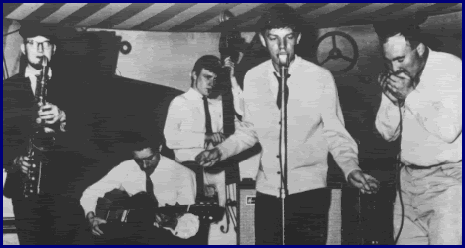
Sonny Boy Williamson IIIn the Summer of 1963, The American Folk Blues Festival arrived in London. Amongst the invited performers was the mysterious Sonny Boy Williamson II. The harmonica player Alex 'Rice' Miller, protege of the legendary Robert Johnson, the only one to know the true details of Johnson's death, and who had later adopted the name of the original Sonny Boy Williamson, also a harmonica player, for himself, enjoyed the experience, and was fĂȘted by a number of members of the young r&b scene, amongst them The Yardbirds , the Stones and The Animals. He began to tour the r&b clubs fronting these bands at a series of gigs, some of which were recorded. On December 30th, 1963, Sonny Boy Williamson and the Animals came to the Club A-Go-Go back in Newcastle, and recorded the performance. Recording was overseen by Giorgio Gomelsky. Still, some are not easily impressed:

"Truthfully, these live shows are more historically interesting than anything else, being merely passable bar band blues" - Steve Leggett All Music Guide

"Ah, knickers!", as Eric exclaims at the very end of the night, after thanking Sonny Boy and thanking the audience for supporting them. There had never been a passable bar blues band before it in the history of Newcastle! Now, a bunch of eager teenagers and their friends in a northern city were working with and learning from a legendary, experienced Delta bluesman, and it undoubtedly improved both their technique and their confidence. That went for the other groups Sonny Boy jammed with that year. When The Rolling Stones made their assault upon America, they made a point of requesting that Sonny Boy Williamson was also booked to appear alongside them on TV, as a mark of their respect.

Here are some tracks from that recording at the Club A-Go-Go, plus The Animals' own homage to the venue that had nurtured them, which was the b-side to the fantastic Please, Don't Let Me Be Misunderstood.

Sonny Boy Williamson & The Animals - Night Time Is The Right Time (From Charley LP The Animals & Sonny Boy Williamson 1977, recorded December 30th 1963 at Club A-Go-Go Newcastle-upon-Tyne)

Sonny Boy Williamson & The Animals - Bye Bye, Sonny, Bye Bye (from Charley LP The Animals & Sonny Boy Williamson 1977)

The Animals - Club A-Go-Go (b-side of Don't Let Me Be Misunderstood Jan 1965)

Its definitely worth visiting The Animals Official Website , run by original guitarist Hilton Valentine, if you want an introduction to their music. Lots of sound clips are available to sample. Photos of The Pagans are property of Philip Payne, and can be found at This Book Of Burdon by Aimee Harrison. Listen to and buy more clips of the 1963 concert on itunes! Quotes from Steve Leggett at All Music Guide, and from A Change Is Gonna Come by Craig Werner.

Saturday, June 09, 2007

Hammer And Nails: The Staples Singers Make This House A Home...

I have just bought my first flat, and I have been busy in the last week packing, moving house, painting and decorating! Ma cherie amour et moi are very happy, and not a little exhausted! Finally, today, my internet was reconnected ...

Naturally, this gives me an opportunity to ramble on about The Staple Singers and to play for you the title song from Hammer And Nails, an album of gospel recorded for the renowned jazz label Riverside Records in 1962. It's taken me quite a while to record this onto my computer, since there was a slight nick on the surface that sticks once in a while. There were tears as I blamed myself for this crime against vinyl, but now I have secured a copy of the single, so enjoy!

By this time, the Staples family were already a well-established gospel group who had performed together for nearly 15 years, since Roebuck Staples, born on December 28, 1915 in Winona, Mississippi, decided to form a family gospel group in 1948, incorporating his bluesy guitar style. His elder daughter Cleotha, younger daughter Mavis, and son Pervis Staples took their places sharing the vocals with their father.

Before that time, Roebuck and his wife Oceola had moved from Mississippi to Chicago during the Depression, and had worked in steel mills and meat-packing plants to support the family. The musical talent of the children encouraged Roebuck to start performing in the local Chicago churches, and by the early 50s, they made the choice to become full-time gospel singers, touring churches across the country. In 1957, they signed with Vee Jay and recorded Uncloudy Day, and it became a nationwide gospel hit. Others followed, including Will the Circle Be Unbroken, Help Me, Jesus, and Swing Down Chariot (Let Me Ride). The greater exposure led to more bookings touring college campuses, concert halls and music festivals:

"Everywhere they go they generate a unique kind of soul-to-soul enthusiasm and give every type of audience a deep emotional thrill." -Gary Kramer

Distinguishing the Staple Singers from other gospel groups was their adherence to a southern gospel style, rather than follow the more polished modern vocal harmony groups. This was exactly the kind of gospel sound that most appealed to the growing white audience interested in the 'authentic' American folk tradition. Looking to expand the label, Riverside Records signed The Staple Singers. Orrin Keepnews, who supervised the Staple Singers sessions, had made his name in the jazz world by signing Thelonius Monk and recording him on a series of seminal albums. In April 4th 1964, the Staple Singers would be performing Hammer And Nails on TV's Hootenanny, recorded for that show at the Purdue University, West Lafayette, in Indiana, alongside The New Christy Minstrels and irish harpist Deidre O'Callaghan.

The period at Riverside would be shortlived. Orrin left the business side to his old friend and partner Bill Grauer. In 1963, Grauer died suddenly, and Riverside went into bankruptcy in 1964. The Staples moved on to the Epic label. Here they would take their exposure to the world of folk and protest song and use it to record songs that mixed gospel with themes of the civil rights movement.

In 1968 when The Staples signed with soul music label Stax Records, they would suffer a certain amount of criticism for this in gospel circles. Yet, musically, the only difference was that the popular music coming out of Memphis was simply taking more of its own influences from the same traditional gospel sources that the Staple Singers had always drawn from. Nor do their message songs exactly abandon their gospel message completely.

On this, the title song from the Hammer & Nails album, which was also a single, contralto Mavis sings a powerful vocal line, using the lines 'More, more more...' to drive the beat forwards and pushing harder and harder up to a crescendo in each chorus that evokes an ecstatic feeling. This version of the song is a very different one to the more widely available recording found on their greatest hits CDs. Inexplicably, Hammer & Nails is the only Riverside track that is not featured on their 'complete' Riverside Recordings CD.

Another interesting fact: throughout the liner notes to this album in 1962, Roebuck is referred to as 'Daddy' Staples. When did he pick up his more familiar monicker of 'Pops'?


The Staple Singers - Hammer & Nails (Riverside R-4518, from LP Hammer & Nails 3501)

Information garnered from Rob Bowman's summary of the Staple Singers career, info from The Rosebud Agency, and liner notes by Gary Kramer.

Friday, May 25, 2007

Soul Britannia: It's All Over Now...

It was their most intimidating audience to date.

As they entered the Co-Op Ballroom in Nuneaton, Mick Jagger, Keith Richards, Charlie Watts, Brian Jones, Bill Wyman and Ian Stewart did not know what to expect. Tension was high. They set up, were introduced, and began to play their brand of rhythm and blues...

The audience, mostly children from the age of 4 to 10, were not impressed, and proceeded to pummel the Rolling Stones continuously with cream cakes until they left the stage.

"They did not appreciate r&b", said Bill Wyman sadly, looking back on that ordeal.


For the fledgeling r&b band, success and recognition was not coming easy. It was all very well to play at The Marquee on the nights when Blues Incorporated were unavailable, but other venues and appreciative audiences were still very thin on the ground.

But, in 1963, while the Stones searched for gigs and practiced being jammy dodgers, the r&b scene that had grown around the clubs of London was now spreading. The Ealing Club grew from 100 members the first week to 200 memebers the next, to over 800 by the end of 1962, some having wandered to its doors in search of the blues from as far away as Scotland. By 1964, most of the clubs of Wardour Street and West London had gone over to featuring r&b over modern jazz. The Stones finally found a home away from the Marquee, this time in Richmond, at the Crawdaddy Club. Richmond could boast a number of other venues turning to r&b, such as the Eel Pie Hotel, The Station Hotel, The Imperial, and L’Auberge. Approximately 10,000 people were likely to enter the doors of these London clubs alone in a typical week to pick up the r&b sounds.

And the trend had spread outside the capital. By late 1963, rhythm & blues clubs were forming all over: from St Andrew's Hall in Norwich, the Olympia in Reading, the R&B Club in Andover, the Rhythm & Blues Club at the Maritime Hotel in Belfast, and the Downbeat Club and Club A-G0-Go in Newcastle, to the Starlight Rooms in Brighton. It must be said, however, that while now these clubs were bringing r&b closer to British youth, they are all situated in ports, near American bases or close to London.

Rhythm and blues was going to be the new musical wave, then, after all. It had not been inevitable, or even likely. But for a number of reasons, r&b now appealed. It is often suggested that this was simply because Britain was still haunted by the spectre of World War II, and had a yearning for the trappings of America. Yet as my dad told me recently, there had been a number of reasons why rock and roll had become adulterated and tamed in its British version by the early 60s:

"You have to remember, for a lot of people, even young people, rock and roll had been connected with the Teds. Many ordinary people thought they were violent, dangerous thugs. They were outcasts, troublemakers from the working class [so people assumed]... So a lot of people wanted nothing to do with anything these troublemakers enjoyed. In any given week, at least half of the Hit parade would be filled up with ballads and popular tunes by people like Alma Cogan. That's what most people wanted to hear, right up to the mid Sixties."

In fact, Britain benefitted from a veneer of prosperity and more spending power in people's pocket, largely due to the removal of rationing and a series of canny devaluations by the MacMillan government during the late 50s. More and more young people were growing up into a comfortable suburban life that had cultural, educational and creative advantages. There was more money for instruments, more opportunity to enjoy the nightlife, the chance for free university education and growing enrollment at art schools. Here, a relatively small number of young people were introduced to jazz and then the blues, and had a chance to play and experiment. So affluence, leisure time and money in pockets was making it possible to adopt new American trends, after a fashion, in a way that had never truly happened in Britain before.

Some have said that in fact it was easier for British youth to take up r&b than it was for their contemporary white Americans. This is perhaps an oversimplification, as it ignores the way southern soul in particular was formed interracially in Memphis and Muscle Shoals, to name but two examples. However, naively obsessed with all things American, with access to far fewer media accounts of the realities of American society, British youth were far happier than white Americans to simply accept that jazz, blues and r&b was at the heart of 'American' music. The main objection to r&b in Britain was its noisiness, young people's unprofessional musicianship and the length and cleanliness of the bands' hair.

Was the music that they made r&b? It was certainly different to the rhythm & blues Americans were used to, They couldn't play as well, they couldn't sing at all American, and they had nobody to refer to except for the twenty or so records they had in their bedroom. They had grown up with very different influences to their black American heroes, from skiffle, to old folk ballads, to music hall songs, and these influences naturally permeated the songs that they began to write for themselves. So ultimately, British r&b changed into something unlike its beginnings, and took a course far removed from the course of black American music in the late 60s and 70s. But it was inspired by and dedicated to the seven-inch pieces of vinyl they had listened to note for note in those early years...

SO, who was playing this r&b hybrid? Time for some more music posts!

Information quoted from the chapter 'Enter The Stones' in 'White Heat: A History of Britain in the Swinging Sixtes' by Dominic Sandbrook, and 'Mod: A Very British Phenomenon' by Terry Rawlings. Blue Eyed Handsome Dad helped with some memories also!
NOTE TO READERS: Tomorrow I am starting to move house. So I have to wait for a few days to get my internet reconnected in the new flat. So I apologise in advance if there is a delay in posting more stuff next week. Of course, since I usually get sidetracked and delayed anyway, you may not notice any difference to the usual poor service ! :)

Soul Britannia: Stoned!

The early recordings of the Stones are going to be somewhat humourous to American soul afficionados. But they have their charms. And each song gives some indication of the influences of early British r&b and how a British r&b enthusiast perceived themselves in the early years.

With Come On, the guys attempt to do Chuck Berry for the first time. Clearly terrified of this strange music, the Decca producers constrict the band into a sanitised and clean arrangement that still resembles other tunes by British rock and roll stars of the time. Interestingly, it was not a hit with the r&b crowd, who were disappointed that it did not sound 'authentic', and it only reached No.29. What it does show is that rock and roll was a much bigger element in the influences of British r&b. The b-side, I Want To Be Loved, the Willie Dixon hit popularised by Muddy Waters, is a better track, kept tight by the professional drumming of the jazz musician Charlie Watts, who used to play in Blues Incorporated before joining the younger band. It's blues rather than rhythm and blues, and it's little wonder that early on, British r&b developed a heavy reliance on noisy guitar riffing, and on the power of the harmonica, due to the cheapness of the instrument in comparison with trying to organise a horn section, and the reverence in which blues artists were held by Chris Barber and Alexis Korner and other leaders of the scene.

Next, the Stones turned to songwriters that they idolised, Lennon and McCartney, who gave them I Wanna Be Your Man. Clearly unnerved by the poor response to their first single, both band and Decca Records looked for a sure-fire Beatleesque hit, the only r&b British record companies understood was saleable. The completely unexpected way in which the Beatles had suddenly reached No.1 on the US charts in January 1964 (not 1963 as I previously wrote in a hurry...) stunned everybody, not least themselves, and it had radically changed the way in which young r&b enthusiasts, starting up their own bands, saw their potential. Perhaps they could write their own songs as well as play their favourites.

On the b-side, Stoned shows that there was more to the Rolling Stones than so far meets the eye. It bears the unmistakeable influence of the 1962 hit Last Night by the Mar-Keys, although harmonica takes the place of horns. The British r&b fan was not just a classicist, trying to imitate a revered 'folk' music, however over-earnest some of its proponents sometimes acted (stand up Slowhand...). They were young people excited by an up to the minute sound. This is also a song with a lyric that hardly needs commenting was rather different for British music. The next year, of course, the Rolling Stones would return to the Stax stable to record Rufus Thomas' Walking The Dog for their first album.

The Rolling Stones first self-titled EP, recorded in late 1963, and their second recorded in Chicago in 1964, begin to reveal their true appreciation for some of the masters of r&b, and more closely resemble how they played live...

The Rolling Stones - Come On (Decca 1963)

The Rolling Stones - I Want To Be Loved (Decca 1963)

The Rolling Stones - I Wanna Be Your Man (Decca 1963)

The Rolling Stones - Stoned (Decca 1963)

Sunday, May 13, 2007

Soul Britannia: The Modernists, The Marquee and The Music

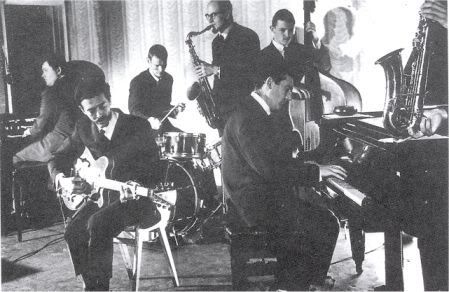
Alexis Korner, Cyril Davies & Blues Incorporated1956. Back to Soho. Home of the jazz clubs and the skiffle clubs. Above The Roadhouse pub on Wardour Street, tired of skiffle and trad jazz, Cyril Davies and Alex Korner are setting up a club night, playing the blues. The night is called the Blues & Barrel House Club. The band is called Blues Incorporated. Who knows if anyone will come?

They come. Big Bill Broonzy and Otis Spann even come down to hear and play, and stay at their houses while they are in town.
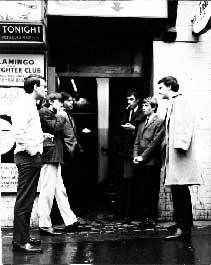
The Flamingo Club on Wardour Street in 1964
They've come down from the Cold War US airforce bases around London, where they've been playing for the servicemen - the only place up to then you could hear the blues in Britain. Like many GIs, they come into Soho, looking for entertainment. First to clubs like the Americana for jazz; then on to Wardour Street to the Barrel House and finally down to the basement club The Flamingo for modern jazz and latest r&b singles from Ray Charles and Lee Dorsey. Mixing with student trad jazz fans, being beatnik in old jumpers and scruffy trousers, the GIs cut a style in suits and ties. Some of the skifflers and jazz musicians are interested: Zoot Money, Georgie Fame And The Blue Flames, Chris Farlowe and the Thunderbirds, are listening and learning.

They interest the younger kids too. From all over London they come to hang out in Soho, young mostly working-class boys who are fascinated by everything American, but can't find it in austerity Britain, can't dress like that, but they try and put on an attitude. They are not going into National Service like their older brothers, the Teds, and coming out aged and conformist. Thanks to the self-same GIs and thanks to mutually assured destruction, the country doesn't need their services. These boys are able to go to work, earn their money, buy clothes, go out, and spend it how they want. They aren't as rich as they make out - you can do a lot on the HP. They want a new kind of life all the same.

At the Flamingo, they can meet real Americans. The GIs can sell you buttoned Levi's for a fiver.
Where do you get those suits, those shirts? They just don't exist in the high street. So you need to find a way to alter things yourself. First, find something you like at Marks & Sparks, or C&A. Round the corner from The Roaring Twenties Club, where blue beat mixes with r&b from 1961, the tailor at Newmans on North End Road will make you a suit with the 'Billy Eckstine collar', or help you get the perfect 'Italian' drop to your trouser. Go to the cinema, and there are new ideas every week. La Dolce Vita with Marcello Mastroianni, Shoot The Pianist with Charles Aznavour, Rocco And his Brothers with Alain Delon, the New Wave. Always new, different, modern, changing. Think of a style, and take it to John Stevens in Fulham, Bilgorri in Bishopsgate. Now show it off at the clubs...

It's not just about the clothes anymore. It's about the music. The GIs have records to sell as well. Better than trad jazz, or skiffle, or Cliff Richard's tame rock and roll. Its a handy extra income, and a way to offload belongings before returning to the States.

March 17th 1962.

The Barasque Club, opposite Ealing Tube Station. Art Wood, singer with Blues Incorporated, asks if the owner wants a new resident band, a blues band. He agrees. Davies and Corner open a new club night, and the faces start to appear from other pockets of London, young, fashion-conscious, a little arrogant, interested in the new sounds. Soon, another club offers them a residency - The Marquee Club, at that time on Oxford Street.

Blues Incorporated in 1963, with a young Mick Jagger having a go on vocals...Clubs in 1962 mean live music, and there are a small but growing coterie of young people who have absorbed the r&b records they have bought, and are starting to play. You'd find Brian Jones in the audience at the Marquee, Mick Jagger taking a turn as a singer with Blues Incorporated, Eric Clapton and other Yardbirds not far behind, Chris Farlowe and especially Georgie Fame and his Blue Flames turning from jazz and skiffle towards r&b at The Flamingo.

A local phenomenon amongst young men and women in London, looking for whatever the latest styles and trends are, trying to make their own identity, has encountered a club life suited to the tastes of GIs and Caribbean-Britons, and heard a music that intrigues them. Something similar is happening in some other places, in Liverpool, and in East Anglia, in smaller towns near other airforce bases. People visiting the London nightlife are bringing back the news and the new sounds to towns across the south. The rest of the country hardly know anything about it, but soon it will become a national youth culture...

Here are some tunes from Blues Incorporated in the early years. The first is taken from an LP recorded live at The Marquee Club in its first few months back in 1962, and released on Ace Of Clubs. The second is the b-side of Blues Incorporated's first single, released in 1963, many years after the formation of the group. I think this reflects the assumptions in Britain at the time that the priority for a band was playing live, and perhaps also that for many British blues musicians, they did not fully consider the idea that they could make records like their own idols. This was about to change dramatically as the recording industry, soon to be bowled over by the public fervour for The Beatles, awoke to the potential of British beat.

Alexis Korner & His Blues Incorporated - Rain Is Such A Lonesome Sound (LP 'R&B From The Marquee Club' ACL1130) 1962
Alexis Korner's & His Blues Incorporated - Please, Please, Please (B-side of Parlophone R 5206) 1963

Information gathered from The Georgie Fame site, The Marquee Club website, The British Beat Boom website (very good index of many bands), and from Mod: A Very British Phenomenon by Terry Rawlings.

Saturday, May 05, 2007

Soul Britannia: Chris Farlowe Says Baby, You're Out Of Time!

Chris Farlowe In The Midnight Hour EP 1966Its the Swinging Sixties!

As I didn't know where to start, I'll start with some of the best!

Amongst the blue eyed soul singers that emerged in the early 60s in Britain, few were as well respected as John Henry Deighton, more famously known as Chris Farlowe.

He had begun like countless other teens in the mid 50s as a skiffle fan, worshipping the grating folksiness of Lonnie Donegan and his ilk. The John Henry Skiffle Band actually won the All-England Skiffle Championship in 1957. Over the next year or so, the repertoire of the rock and roll group gravitated more and more away from rock and roll numbers towards r&b. In 1962, John renamed himself Chris Farlowe, in honour of jazz guitarist Tal Farlow (who at that time had mysteriously 'disappeared' from the jazz scene, to much debate amongst jazz cats) and the band became The Thunderbirds. They got a residency playing at the Flamingo Club in Soho, and were noticed by Decca Records. On their first single, an innocuous number called Air Travel released in November 1962, you can clearly hear the impact that a certain Sam Cooke had had on the country during that year. However, nothing came of the record.

Click Here to listen to Air Travel by Chris Farlowe And The Thunderbirds.


Chris Farlowe & The Thunderbirds
The band then signed a deal with EMI. They were to release a number of singles on the Columbia imprint. Despite creating some great singles the Thunderbirds were not getting hits. Ironically in 1964, when they released a single as The Beazers, called The Blue Beat, in which guitarist Albert Lee mimics the guitar strumming of ska under a conventional r&b melody, they had a dance hit. Albert, who went on to have along career as a respected guitarist across blues and country, joined the band after playing guitar with a number of bands, touring England and doing regular stints in the clubs of Hamburg. He was impressed with what he saw in the Thunderbirds, and stayed for four years:

"In May 1964, I joined Chris Farlowe and I stayed with him four years. I thought it was a great band - the best in Britain at what we did...but we never got much in the way of recognition or public acclaim. It was very frustrating; we'd support bands like The Animals, who were terribly ragged in comparison, with very little feeling or finesse - and they'd go down a storm while we got a smattering of applause from the few punters who weren't in the bar. I've got tapes of some of our gigs and they still stand up - some of our stuff was killer! Farlowe was a dynamite singer! But there was practically no crowd reaction. We worked solidly for years...tours, one nighters, all nighters, doubles, trips to Germany and Scandinavia - we went all over the place, but we never cracked it beyond a certain level."

In 1965, another class tune, Buzz With The Fuzz, was released to much mod acclaim, only to be withdrawn from sale when EMI's management realised that it might constitute a provocation towards the police.

Andrew Loog OldhamThen in 1966 an offer came from Andrew Loog Oldham, manager of the Rolling Stones, who had set up a new label, Immediate Records, which was also distributed by EMI. Not only was Oldham more receptive to the sounds of r&b, he could also call on the songwriting of Jagger and Richards for his artists. Farlowe was impressed , and joined other similarly soul-inflected vocalists such as Steve Marriot of the Small Faces, and later P P Arnold, at the label.

Eric Burdon, of The Animals, was asked to produce Chris Farlowe's first two singles, and was faithful to Farlowe's r&b sentiments, though who knows what Albert Lee thought of him at the time. Some outstanding albums and EPs followed, three in 1966, starting with his showcase of soul classics, Farlowe In The Midnight Hour. Farlowe had garnered so much credibility with British fans that he and Eric Burdon were asked to appear on a special edition of the TV show Ready Steady Go! with Otis Redding.


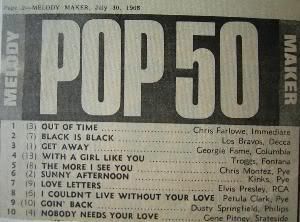
Out Of Time No.1 July 1966 It was the third single, Out Of Time, however, written and produced by Mick Jagger, that struck the right vibe, reaching Number One in July 1966. I think that while often dismissed as a Rolling Stones cover (the Stones recorded it for their album Aftermath earlier in March), and derided for its powerful orchestration, it is a wonderful Deep Soul number, in which Farlowe positively delights in giving a woman the bad news that this relationship is not just going to pick up where she left it after leaving for another man. It was so powerful it enabled England to win The World Cup!

The Beazers (Chris Farlowe & The Thunderbirds) - The Blue Beat (Decca F 11827) 1964

Chris Farlowe - Out Of Time (Immediate IM 035) 1966


Sadly, by 1967 and 1968, the cultural influences arriving in the UK were no longer dominated by soul music, and while other bands were willing and able to adapt and embrace psychedelic culture, Chris Farlowe was struggling to continue in the same r&b vein he had always championed. Despite a series of outstanding relases, the hits dried up, and he was out of a record contract in 1970. Farlowe was not eager to go down the popular cabaret singer route that others like Tom Jones opted for in these years. It must have been a blow to see Rod Stewart that same year acheive a hit with his frankly inferior version of Handbags And Gladrags, a song that had been specifically written for Chris by Mike D'Abo of Manfred Mann. Sadly, it is the Stewart version that semi-Britpoppers The Stereophonics attempted to mimic with their recent hit.

The next few years saw him join up with a number of prog rock bands as a vocalist, including Atomic Rooster and Colosseum, suffer a two year hiatus after a nasty car accident, before leaving the business temporarily in the late 70s. In the 80s, Farlowe decided to return, this time trying to tap into the adult blues market, and has made a successful new career touring solo, with his 70s band Colosseum, a reformed Thunderbirds, and with Albert Lee. So once again you can hear the voice of Chris Farlowe in the North, South, East And West (yes, this is a plug for another great Farlowe track...)

Information about Chris Farlowe from many conversations and the voluminous mod record collection of John Bennett, www.45-rpm.org.uk, and the Chris Farlowe website. Albert Lee quote from O O'Connor's fan site. Photos from the collection of Lisa and Georg, two big Farlowe fans from Germany who were once part of German beat band The Fenders. Request to hear The Blue Beat came from Blue Eyed Handsome Dad!

Soul Britannia: The Jury's Still Out There...

While perusing the internet for info about Chris Farlowe, I read this excerpt from an interview with guitarist Albert Lee. It gives a little bit of an insight into the influence of US airbases, r&b, and the Caribbean community on the beat explosion:

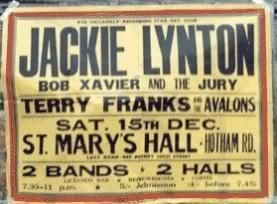
"In 1961 ... I ran into this bloke called Bob Xavier, who asked me to join his band. So I wore a variety of open necked silky shirts and worked American airbases and London clubs for over a year.

Bob Xavier was West Indian, and the band was modelled on Emile Ford and the Checkmates. Most other groups around town were still doing rock'n'roll, but we were into Drifters/Brook Benton sort of stuff...but in summer '62 Xavier left and we became the house band at the 2Is [paid 18 bob a night].

We'd play in the cofee bar 5 or 6 nights a week - backing whoever wandered onto the stage...and at weekends we would go out of town doing one-nighters backing Vince Eager, Keith Kelly and Jackie Lynton (who were all managed by Tom Littlewood - owner of the 2Is at the time)."

The band were called Bob Xavier & The Jury, and recorded a single with Jackie Lynton after Bob Xavier left. I found a picture of an old gig poster, but nothing else concerning Bob Xavier, or what he went on to do. If anybody knows anything about Bob Xavier and The Jury, I'd love to here from you!